Thursday, December 29, 2011

Dead End


Dithering at the Top Turned EU Crisis to Global Disaster
BRINK-bottom
By CHARLES FORELLE and MARCUS WALKER
At a closed-door meeting in Washington on April 14, Europe's effort to contain its debt crisis began to unravel.
Inside the French ambassador's 19-bedroom mansion, finance ministers and central bankers from the world's largest economies heard Dominique Strauss-Kahn, then-head of the International Monetary Fund, deliver an ultimatum.
Greece, the country that triggered the euro-zone debt crisis, would need a much bigger bailout than planned, Mr. Strauss-Kahn said. Unless Europe coughed up extra cash, the IMF, which a year earlier had agreed to share the burden with European countries, wouldn't release any more aid for Athens.
The warning prompted a split among the euro zone's representatives over who should pay to save Greece from the biggest sovereign bankruptcy in history. European taxpayers alone? Or should the banks that had lent Greece too much during the global credit bubble also suffer?
The IMF didn't mind how Europe proceeded, as long as there was clarity by summer. "We need a decision," said Mr. Strauss-Kahn.
It was to be Europe's fateful spring. A Wall Street Journal investigation, based on more than two dozen interviews with euro-zone policy makers, revealed how the currency union floundered in indecision—failing to address either the immediate concerns of investors or the fundamental weaknesses undermining the euro. The consequence was that a crisis in a few small economies turned into a threat to the survival of Europe's common currency and a menace to the global economy.
In April, after a year of drama and bailouts, the euro zone seemed to have contained the immediate crisis to Greece and other small countries. Crucially, euro-zone economies such as Spain and Italy had avoided the panicked flight of capital. They were still able to borrow money at affordable rates in the bond market.
 But by July, the rift among euro-zone leaders over who should bear the burden of Greece's debt had prompted investors to shun all financially fragile euro nations. Like a wildfire, the spreading uncertainty threatened to engulf the whole of Europe's indebted south, to outstrip the resources of its richer north and to burn down the symbol of Europe's dream of unity, its single currency.
Now, as the bloc's leaders rush to forge a closer political union, the lesson of that period looms large. Investor trust in public debt is part of the foundation on which all nation-states depend. And in Europe's common currency—a unique experiment with the livelihoods of 330 million people—nations will win or lose that trust together.
The dispute at the Washington meeting divided two of the Continent's grand old men, both of them born in 1942 and both among the fathers of the euro.
BRINK-top
Wolfgang Schäuble, Germany's ascetic and irascible finance minister, understood the IMF's ultimatum. The euro zone would have to draw up a second bailout package for Greece by summer, just a year after a loan deal for €110 billion, or $140 billion.
But this time, Mr. Schäuble said, "We cannot just buy out the private investors" with taxpayer money. That would reward reckless lending, he said, and it would never get through an increasingly impatient German parliament. Greece's bondholders would be required to lend more money, Mr. Schäuble proposed, rather than take payment for their bonds at maturity.
Jean-Claude Trichet, the urbane French head of the European Central Bank, warned against forcing bondholders to put in more money, which would effectively delay repayment. "This is not a good way to go in a monetary union," Mr. Trichet said. "Investors would avoid all euro-area bonds."
Mr. Trichet, in the twilight of a 36-year career as a finance official, feared that if Greece didn't honor its bond debts on time, the implicit trust that kept credit flowing to many weak euro-zone governments would shatter. More countries and their banks would lose access to capital markets, in a chain reaction with incalculable consequences.
The April meeting ended inconclusively.
Meanwhile, the cost for fixing Greece was rising. The Athens government's budget deficit was stuck at a stubbornly high level.
Italian and Spanish borrowing costs were still affordable and stable. The yield on Spain's 10-year bonds hovered around 5.3%; on Italy's, around 4.6%.
The debate over making bondholders contribute to the new funding package for Greece—known as private-sector involvement, or PSI—divided euro-zone countries.
Germany had allies. In the Netherlands and Finland, new governments had promised voters they wouldn't pay for problems in less-frugal Mediterranean countries. Breaking those promises would risk rebellions in parliament.
But France joined the ECB in resisting burden-sharing by bondholders. France's banks had lent more heavily than Germany's to Greece and other indebted euro nations, and France fretted about a Lehman Brothers-style banking-system meltdown. Italian officials also feared that a precedent for losses in Greece would scare investors away from Italy's bonds.
Three weeks after the Washington gathering, on Friday, May 6, panic erupted. German news weekly Der Spiegel reported that Greece was thinking of leaving the euro zone, with policy makers heading to a secret meeting that night in Luxembourg.
The report was half-right. There was a meeting, but Greece was staying put.
Inside a country chateau, top euro-zone officials told Greece's finance minister they expected deeper austerity and faster reforms in return for a new aid package.
Then Mr. Schäuble said he wanted to discuss how bondholder burden-sharing would work. The usually smooth-mannered Mr. Trichet lost his patience. "I want to put my position on the record," he said: "I don't agree with private-sector involvement, so I won't take part in a discussion about the practicalities." He stormed out.
Mr. Trichet's assent was vital. If the ECB were to stop accepting Greek bonds as collateral for its lending to banks on the grounds that the bonds were in default, then Greece's banks, which were stuffed full of their government's bonds, would quickly run out of cash and collapse. That would radically drive up the cost of a rescue.
In Greece, a new wave of mass strikes and demonstrations was starting. Protesters, angry about Europe's imposition of extra spending cuts and tax hikes, clashed with police in front of the Athens parliament in the biggest and most violent protests in a year.
Spanish and Italian bond prices remained stable. But Europe was at a dangerous impasse over Greece.
Many euro-zone governments hoped Mr. Strauss-Kahn could find a way to relax the IMF's summer deadline. The IMF chief was due to discuss the matter with German Chancellor Angela Merkel in Berlin on May 15, and with euro-zone finance ministers in Brussels the next day.
Mr. Strauss-Kahn couldn't attend. Police in New York pulled him off his Paris-bound flight and charged him with sexually assaulting a hotel chambermaid. (The charges were later dropped, and prosecutors said they doubted the maid's reliability.) An aide phoned Ms. Merkel at her central-Berlin home that Saturday and told her the news. The astonished chancellor responded with a German idiom that translates roughly as: "You couldn't make this up."
The IMF sent a lower-ranking official to Brussels in his place who had no latitude to deviate from the IMF's deadline.
In Athens, meanwhile, a tent city of the "Indignant" protest movement—a groundswell of anger at the country's impoverishment—sprang up outside parliament. Spain's bond prices began to wobble as investors worried that other countries might also face debt restructuring.
On June 1, Mr. Schäuble's deputy, Jörg Asmussen, presented a German plan at a meeting of finance officials in Vienna, at the Hofburg palace of the former Habsburg emperors. It involved pressuring Greece's bondholders to swap their Greek debt for new IOUs that would come due far in the future. That would cut the amount of European taxpayer funding Greece would need.
After a meal in a palace banquet hall, the officials quarreled into the wee hours.
For the ECB, Mr. Trichet's deputy Vitor Constâncio, of Portugal, denounced the German plan as "dangerous." Credit-rating agencies would declare Greece to be in default on some of its debts—a so-called selective default. In that case, Mr. Constâncio warned, the ECB would refuse to accept Greek government bonds as collateral, dealing a death blow to Greek banks. France, Italy and Spain all supported Mr. Constâncio.
Germany's Mr. Asmussen shot back with a threat of his own. Europe needed Germany's money to fund a new program of Greek loans. "Without private-sector involvement," he said, "there will be no program."
Greece was descending into chaos. Embattled premier George Papandreou's slender majority in parliament was fraying. On June 15, a swelling demonstration in Athens's central square veered out of control.
Alone in his office, Mr. Papandreou phoned the parliamentary opposition leader and offered to make way for a national-unity government. Talks broke down, and the Greek government limped on badly wounded.
Even Ms. Merkel had some doubts about her finance ministry's hard-line insistence that Greece's bondholders take a loss. On June 17, she discussed a softer plan with French President Nicolas Sarkozy: a gentleman's agreement under which Greek bonds would be honored but the bondholders would volunteer to buy new ones.
Mr. Schäuble pushed back. The veteran conservative politician was Berlin's biggest supporter of the European dream, but he was also the keeper of Germany's purse. He was determined to make banks share the burden with German taxpayers, and he didn't trust them to keep a gentleman's agreement.
When finance ministers met again on June 20, Mr. Schäuble pushed harder. Greece's bondholders should be told not merely to accept a delay in repayment, he said, but also to forgive some Greek debt—a so-called haircut.
As Greece's economy moved toward free fall, its debts were soaring beyond the country's ability to pay, the Germans and their northern allies argued. Mr. Trichet and the southern countries resisted. Talks dragged on for hours. The ministers knew they couldn't leave without some agreement.
They tried to please everyone: Greece would get more aid. Bondholder losses would be substantial, to placate the Germans, Dutch and Finns. But as the ECB insisted, they would avoid pushing Greece into selective default.
Investors knew you couldn't have it both ways. As the threat of a Greek debt restructuring sank in, Southern Europe's bond markets grew volatile. Spain's 10-year bond yield rose above 5.6%. Italy's reached 4.9%.
Greece's parliament debated the extra austerity measures that Europe demanded. Central Athens erupted in violent protests. Anarchist youths tore up chunks of paving stone and threw them at riot police, who fired back with tear gas and stun grenades. Café parasols burned.
Europe hadn't resolved how to keep Greece afloat. The IMF—whose demand for a decision had set off the whole argument—softened its ultimatum. IMF officials said they were satisfied that Europe would sort out some kind of new bailout, and wired Greece its summer aid payment on July 8.
It wasn't enough to calm markets. Spain's bond yield hit 6.3%. Italy's rose to over 5.8%. Such borrowing costs, if sustained, would make it hard for both countries to rein in their debts.
The selloff in bond markets forced leaders to call an emergency summit for July 21.
Determined not to let the summit pass without an agreement, Ms. Merkel invited the French president, who objected to the German push for bondholder losses, to Berlin. The pair and their advisers met for dinner in the German chancellery the night before the meeting.
Few of them had time to touch the duck breast and vegetables on their plates as they searched for a compromise. Finally, Mr. Sarkozy said he would accept the private-sector involvement—if Ms. Merkel dropped her resistance to giving the euro-zone bailout fund broad new powers to buy debt of weak countries directly and move to protect such countries as Spain and Italy from bond-market contagion. Ms. Merkel agreed.
One more person needed to sign off. Ms. Merkel phoned Mr. Trichet at his Frankfurt office. He took the last Lufthansa flight to Berlin and arrived at the chancellery around 10 p.m.
Reluctantly, Mr. Trichet gave his OK. But he set conditions. Governments would have to insure Greek bonds against default so that the ECB could continue to accept them as collateral. And they would have to make plain that no other euro country but Greece would have its debts restructured.
The trio's deal was both complicated and vague. Their staffs had little time to flesh out details before the next day's summit in Brussels. As leaders trickled into the European Union's boxy headquarters, Ms. Merkel faced a challenge to placate the euro zone's south, which thought private-sector involvement was dangerous, and its north, which thought it didn't go far enough.
When the leaders assembled at the sprawling summit table, Ms. Merkel admitted that the specter of bondholder losses was causing market unrest. But, she said, some Greek debt relief was essential. Without it, the bailout's tough austerity conditions—made tougher by Greece's missing its budget goals—would be seen as unbearable.
"If Greece had met its program parameters in April," she snapped, "that would have helped."
All 17 euro nations had to agree to private-sector involvement. But presented with a calculation that the plan would reduce Greece's debt by only about €19 billion out of more than €350 billion total, Dutch Prime Minister Mark Rutte balked. If it's only €19 billion, he said, "I'm out. I need more."
Finnish premier Jyrki Katainen also complained. His parliament wanted collateral in exchange for more Finnish lending to Greece. "No collateral, no agreement from me," he said.
Mr. Sarkozy was peeved. "All our parliaments can cause problems," he said.
Then it was Slovakia's turn. Prime Minister Iveta Radičová was fighting to keep her coalition together over aid for Greece—a richer country than her own. Adding more powers to the bailout fund "would be suicide," she said.
Greece's Mr. Papandreou pleaded for help. "If we can't solve even Greece, we won't be seen as being able to solve anything else," he said.
Hours later, the leaders had a communiqué. To appease the holdouts, it left key points broad and noncommittal, offering the possibility of collateral to Finland and describing the complex bondholder deal in a few strokes, vague language that would return to haunt the bloc.
Officials struggled to explain the new Greek bailout and the bondholder losses. Amid the confusion, Mr. Rutte dispensed muddled numbers. Bank analysts put out flawed reports.
Investor confidence faltered as it became clear that Europe's compromise achieved the worst of all worlds. Greece would be pushed into a historic default—the first time in nearly 60 years that a developed, Western country wouldn't honor its debts. But the default was so small that Greece was still left with a crushing debt burden.
And then official Europe went on vacation: Ms. Merkel to the Italian Alps, Mr. Sarkozy to the French Riviera.
Bondholders didn't. They went on a rampage.

No Land of Plenty


German economy forces 'still sprightly' pensioners back into work
By Eloi Rouyer and Francois Becker
Germany, as Europe's top economy, may be seen as the land of plenty but its senior citizens are increasingly being forced to take a part-time job in their twilight years just to make ends meet.
With more inhabitants over the age of 65 than any of its European partners, Germany's senior citizens are having to resort to jobs such as a caretaker, animal- or babysitting to top up their pensions.
Notices such as “Still sprightly pensioner, in good physical and intellectual shape, seeks work paying at least 400 euros (US$536) a month. Good knowledge of computers,” are common on specialist sites posting job adverts.
Such sites tend to have a column dedicated to pensioners listing so-called “mini-jobs” targeting those within the country's 20-million-strong retired population in need of boosting their incomes.
“Two or three times a week I deliver newspapers,” 69-year-old Norbert Mack, who lives in Sindlingen, a western suburb in the city of Frankfurt, told AFP.
“Mostly they are free papers with advertising which arrive around midday, so you then need two or three hours to deliver a pile of 200 to 300 papers,” he said.
“I do my round in the area with a shopping trolley. After that, I'm tired and I need to nap for one or two hours at home,” said Mack, who used to be employed in industrial machine construction.
The job earns him about 180 euros every month which supplements his 1,500-euro pension which he and his ill wife live on.
“Our only little pleasures are an old car, a small allotment where we spend the holidays and of course, my dog,” said Mack, whose hobby is training German shepherd dogs.
'I could survive but not live'
Initially created in 2003 by the Social Democratic government of then chancellor Gerhard Schroeder to fight unemployment, these low-paid “mini-jobs,” which are taxed at lower rates, proved a hit among the over-65 year-olds.
And about 11 percent of people who hold down “mini-jobs” are in this age category, according to the central office which oversees this type of work.
“Pensioners regularly ask us for work,” said Walter Ofer, from an association helping pensioners, adding that as well as senior citizens who work to top up their pensions, many women took jobs as cleaners off the books.
At 72, Gerda Hafermalz, who used to be employed in customer service, promotes Swiss cheeses in supermarkets around the eastern region of Erfurt.
“Of course, it was imperative for me to find this work. Either I sat crying over my fate or I took my destiny in my hands,” said the divorcee who describes herself as “tough.”
“My pension gives me 880 euros a month and there's 375 of it that goes on my rent. Without the money my job gives me I could survive but not live,” she said.
Germany has seen the number of pensioners taking jobs to top up their income increase by more than 58 percent between 2000 and 2010, according to the German labor ministry. In 2000 they numbered some 417,000, rising to 661,000 in 2010.
According to Eurostat, Germany has the most inhabitants over the age of 65 in Europe, representing 20.6 percent of its population.
The retirement age is due to gradually go up from 65 to 67 years following a reform approved in 2007.

Sympathy Deformed


Misguided compassion hurts the poor
A scramble for rotting fish: decades of foreign aid have not helped Tanzanians.
By Theodore Dalrymple
To sympathize with those who are less fortunate is honorable and decent. A man able to commiserate only with himself would surely be neither admirable nor attractive. But every virtue can become deformed by excess, insincerity, or loose thinking into an opposing vice. Sympathy, when excessive, moves toward sentimental condescension and eventually disdain; when insincere, it becomes unctuously hypocritical; and when associated with loose thinking, it is a bad guide to policy and frequently has disastrous results. It is possible, of course, to combine all three errors.
No subject provokes the deformations of sympathy more than poverty. I recalled this recently when asked to speak on a panel about child poverty in Britain in the wake of the economic and financial crisis. I said that the crisis had not affected the problem of child poverty in any fundamental way. Britain remained what it had long been--one of the worst countries in the Western world in which to grow up. This was not the consequence of poverty in any raw economic sense; it resulted from the various kinds of squalor--moral, familial, psychological, social, educational, and cultural--that were particularly prevalent in the country
My remarks were poorly received by the audience, which consisted of professional alleviators of the effects of social pathology, such as social workers and child psychologists. One fellow panelist was the chief of a charity devoted to the abolition of child poverty (whose largest source of funds, like that of most important charities in Britain's increasingly corporatist society, was the government). She dismissed my comments as nonsense. For her, poverty was simply the "maldistribution of resources"; we could thus distribute it away. And in her own terms, she was right, for her charity stipulated that one was poor if one had an income of less than 60 percent of the median national income.
This definition, of course, has odd logical consequences: for example, that in a society of billionaires, multimillionaires would be poor. A society in which every single person grew richer could also be one in which poverty became more widespread than before; and one in which everybody grew poorer might be one in which there was less poverty than before. More important, however, is that the redistributionist way of thinking denies agency to the poor. By destroying people's self-reliance, it encourages dependency and corruption--not only in Britain, but everywhere in the world where it is held.
I first started thinking about poverty when I worked as a doctor during the early eighties in the Gilbert Islands, a group of low coral atolls in an immensity of the Central Pacific. Much of the population still lived outside the money economy, and the per-capita GDP was therefore extremely low. It did not seem to me, however, that the people were very poor. Their traditional way of life afforded them what anthropologists call a generous subsistence; their coconuts, fish, and taros gave them an adequate--and, in some respects, elegant--living. They lived in an almost invariant climate, with the temperature rarely departing more than a few degrees from 85. Their problems were illness and boredom, which left them avid for new possibilities when they came into contact with the outside world.
Life in the islands taught me a lively disrespect for per-capita GDP as an accurate measure of poverty. I read recently in a prominent liberal newspaper that "the majority of Nigerians live on less than $1 a day." This statement is clearly designed less to convey an economic truth than to provoke sympathy, evoke guilt, and drum up support for foreign aid in the West, where an income of less than $1 a day would not keep body and soul together for long; whereas it is frequently said that one of Nigeria's problems is the rapid increase in its population.
As it happens, an island next door (in Pacific terms) to the Gilbert Islands was home to an experiment in the sudden, unearned attainment of wealth. Nauru, a speck in the ocean just ten miles around, for a time became the richest place on earth. The source of its sudden riches was phosphate rock. Australia had long administered the island, and the British Phosphate Commission had mined the phosphate on behalf of Australia, Britain, and New Zealand; but when Nauru became independent in 1968, the 4,000 or so Nauruans gained control of the phosphate, which made them wealthy. The money came as a gift. Most Nauruans made no contribution to the extraction of the rock, beyond selling their land. The expertise, the management, the labor, and the transportation arrived from outside. Within just a few years, the Nauruans went from active subsistence to being rentiers.
The outcome was instructive. The Nauruans became bored and listless. One of their chief joys became eating to excess. On average, they consumed 7,000 calories per day, mainly rice and canned beef, and they drank Fanta and Chateau d'Yquem by the caseload. They became the fattest people on earth, and, genetically predisposed already to the illness, 50 percent of them became diabetic. It was my experience of Nauru that first suggested to me the possibility that abruptly distributing wealth has psychological effects as well as economic ones.
I next spent a few years (1983 to 1986) in Tanzania, a country that presented another experiment in treating poverty as a matter of maldistribution. Julius Nyerere, the first--and, until then, the only--president, had been in charge for more than 20 years. His honorific, Mwalimu--Teacher--symbolized his relation to his country and his people. He had become a Fabian socialist at the University of Edinburgh, and a more red-blooded one (according to his former ally and foreign minister, Oscar Kambona, who fell out with him over the imposition of a one-party socialist state) after receiving a delirious, orchestrated reception in Mao's China.
One can say a number of things in Nyerere's favor, at least by the standards of post-independence African leaders. He was not a tribalist who awarded all the plum jobs to his own kind. He was not a particularly sanguinary dictator, though he did not hesitate to imprison his opponents. Nor was he spectacularly corrupt in the manner of, say, Bongo of Gabon or Moi of Kenya. He was outwardly charming and modest and must have been one of the only people to have had good personal relations with both Queen Elizabeth II and Kim Il-sung.
Nyerere wished the poor well; he was full of sympathy and good intentions. He thought that, being so uneducated, ignorant, and lacking in resources, the poor could not spare the time and energy--and were, in any case, unqualified--to make decisions for themselves. They were also lazy: Nyerere at one point complained about the millions of his fellow countrymen who spent half their time drinking, gossiping, and dancing (which suggested to me that their lives were not altogether intolerable).
But Nyerere knew what to do for them. In 1967, he issued his famous Arusha Declaration, named for the town where he made it, committing Tanzania to socialism and vowing to end the exploitation of man by man that made some people rich and others poor. On this view of things, the greater accumulation of wealth, either by some individuals or by some nations, could be explained only by exploitation, a morally illicit process. The explanation for poverty was simple: some people or nations appropriated the natural wealth of mankind for themselves. It was therefore a necessary condition of improvement, as well as a form of restitution, that they no longer be allowed to do so and that their wealth be redistributed. So Tanzania nationalized the banks, appropriated commercial farms, took over all major industry, controlled prices, and put all export trade under the control of paragovernmental organizations.
There followed the forced collectivization of the rural population--which is to say, the majority of the population--into Ujamaa villages. Ujamaa is Swahili for "extended family"; as Nyerere insisted, all men were brothers. By herding the people into collectivized villages, Nyerere thought, the government could provide services, such as schools and clinics. After all, rich countries had educated and healthy populations; was it not evident that if the Tanzanian people were educated and healthy, wealth would result? Besides, collectively the villagers could buy fertilizer, perhaps even tractors, which they never could have done as individuals (assuming, as Nyerere did, that without government action there would be no economic growth). Unfortunately, the people did not want to herd fraternally into villages; they wanted to stay put on their scattered ancestral lands. Several thousand were arrested and imprisoned.
The predictable result of these efforts at preventing the exploitation of man by man was the collapse of production, pauperizing an already poor country. Tanzania went from being a significant exporter of agricultural produce to being utterly dependent on food imports, even for subsistence, in just a few years. Peasants who had once grown coffee and sold it to Indian merchants for soap, salt, and other goods uprooted their bushes and started growing meager amounts of corn for their own consumption. No reason existed for doing anything else because growers now had to sell their produce to paragovernmental procurement agencies, which paid them later, if at all, at derisory prices in a worthless currency that peasants called "pictures of Nyerere."
Nyerere blamed shortages of such commonplaces as soap and salt on speculators and exploiters, rather than on his own economic policies. He made the shortages the pretext for so-called crackdowns, often directed at Indian traders, which eventually drove them from the country. Nyerere's policies were no more soundly based than those of Idi Amin, who drove out the Indians more brutally. Anti-Semitism, it has often been said, is the socialism of fools. I would put things another way: socialism is the anti-Semitism of intellectuals.
With foreign exchange exhausted, only the funds that the honey-tongued Nyerere continued to obtain from the World Bank and foreign donors enabled the country to avoid mass starvation. By the time I reached Tanzania, the country had become completely dependent on handouts. Aid represented two-thirds of Tanzania's foreign-exchange earnings; one might say that its largest export was requests for such aid. In the rural area where I lived, the people dressed in hand-me-downs sent by European charities. A single egg was a luxury. One of the goals that had induced Nyerere to move to socialism, ironically, was national "self-reliance."
The foreign aid that allowed Nyerere's policies to continue well after the economic disaster was evident had precisely the baleful effects that Peter Bauer, the development economist who contradicted the professional orthodoxies of his time, predicted. The aid immensely increased the power of the sole political party by giving its officials control over scarce goods. When I was in Tanzania, you needed political connections to buy even a bottle of beer--the famous local monopoly brand, Safari, which, the saying went, caused you to pass directly from sobriety to hangover without passing through drunkenness. The regime provided ample opportunities for corruption. Most Tanzanians were slender; you could recognize a party man by his girth.
Thanks to foreign aid, a large bureaucracy grew up in Tanzania whose power, influence, and relative prosperity depended on its keeping the economy a genuine zero-sum game. A vicious circle had been created: the more impoverished the country, the greater the need for foreign aid; the greater the foreign aid, the more privileged the elite; the more privileged the elite, the greater the adherence to policies that resulted in poverty. Nyerere himself made the connection between privilege and ruinous policies perfectly clear after the International Monetary Fund suggested that Tanzania float its currency, the Tanzanian shilling, rather than maintain it at a ridiculously overvalued rate. "There would be rioting in the streets, and I would lose everything I have," Nyerere said.
Long years of living under this perverse regime encouraged economically destructive attitudes among the general population. While I was impressed by the sacrifices that Tanzanian parents were willing to make to educate their children (for a child to attain a certain stage of education, for example, a party official had to certify the parents' political reliability), it alarmed me to discover that the only goal of education was a government job, from which a child could then extort a living from people like his parents--though not actually from his parents, for he would share his good fortune with them. In Tanzania, producing anything, despite the prevailing scarcity of almost everything, became foolish, for it brought no reward.
When I returned to practice among the poor in England, I found my Tanzanian experiences illuminating. The situation was not so extreme in England, of course, where the poor enjoyed luxuries that in Tanzania were available only to the elite. But the arguments for the expansive British welfare state had much in common with those that Nyerere had used to bring about his economic disaster. The poor, helpless victims of economic and social forces, were, like Ophelia in the river, "incapable of their own distress." Therefore, they needed outside assistance in the form of subsidies and state-directed organizations, paid for with the income of the rich. One could not expect them to make serious decisions for themselves.
This attitude has worked destruction in Britain as surely as it has in Tanzania. The British state is today as much a monopoly provider of education to the population as it is of health care. The monopoly is maintained because the government and the bureaucratic caste believe, first, that parents would otherwise be too feckless or impoverished to educate their children from their own means; and second, that public education equalizes the chances of children in an otherwise unequal society and is thus a means of engineering social justice.
The state started to take over education in 1870, largely because the government saw a national competitor, Prussia, employing state power to educate its children. But practically all British children went to school already: according to the calculations of economist and historian E. G. West, 93 percent of the population was by then literate. It is true that the British state had started providing support to schools long before, but in 1870, 67 percent of school income still came from the fees that parents paid.
Not all British children received a good education before the state intervened: that was as vanishingly unlikely then as it is today. But it is clear that poor people--incomparably poorer than anyone in Britain today--were nonetheless capable of making sacrifices to carry out their highly responsible decisions. They did not need the state to tell them that their children should learn to read, write, and reckon. There is no reason to suppose that, left alone, the astonishing progress in the education of the population during the first three-quarters of the nineteenth century would not have continued. The "problem" that the state was solving in its destruction of the voluntary system was its own lack of power over the population.
As in Tanzania, the state-dominated system became self-reinforcing. Because of the high taxation necessary to run it, it reduced the capacity and inclination of people to pay for their own choices--and eventually the habit of making such choices. The British state now decides the important things for British citizens when it comes to education and much else. It is no coincidence that British advocates of the cradle-to-grave welfare state were great admirers of Julius Nyerere--who, incidentally, has been proposed for Roman Catholic canonization, thus bringing close to reality Bauer's ironic reference to him as Saint Julius.
The only time I ever saw Nyerere in person was in Dodoma, the dusty town designated to become Tanzania's new capital. He was expected to drive by, and by the side of the road sat a praise singer--a woman employed to sing the praises of important people. She was singing songs in praise of Nyerere, of which there were many, with words such as: "Father Nyerere, build and spread socialism throughout the country and eliminate all parasites."
The great man drove past in a yellow Mercedes. The praise singer was covered in dust and started to cough.

Wednesday, December 28, 2011

Do No harm

The Rise of Government and the Decline of Morality


by James A. Dorn 
The recent financial crisis has expanded the power of government. Tea parties have revealed the disillusion of millions of Americans with the rise of government and the decline of morality. The crisis has damaged, unfairly, the vision of market liberalism. It is essential, therefore, to reexamine and articulate the principles of a free society and to understand the danger to liberty that the new progressivism poses.
Since this essay was first presented at the historic Chautauqua Institution in 1995, the federal government has grown in size and scope. Today Congress spends nearly $4 trillion, the federal share of GDP has risen to 25 percent, and the U.S. debt exceeds $12 trillion. Washington has bailed out financial, insurance, and automobile firms while also taking control of the mortgage market. We are now more dependent on government for our health care, pensions, and future than ever before.
Politicians thrive on using other people’s money and promising free lunches. The growth of government has politicized life and weakened the nation’s moral fabric. Government intervention—in the economy, the community, and society—has increased the payoff from political action and reduced the scope of private action. People have become more dependent on the State and have sacrificed freedom for a false sense of security.
One cannot blame government for all of society’s ills, but there is no doubt that economic and social legislation, especially since the mid-1960s, has had a negative impact on individual responsibility. Individuals lose their moral bearing when they become dependent on government. Subsidies, bailouts, and other aspects of the “nanny state” socialize risk and reduce individual accountability. The internal moral compass that normally guides individual behavior will no longer function when the State undermines incentives for moral conduct and blurs the distinction between right and wrong.
More government spending is not the answer to our social, economic, or cultural problems. The task is not to reinvent government or to give politics meaning; the task is to limit government and revitalize civil society. Government meddling will only make matters worse.
If we want to help the disadvantaged, we do not do so by making poverty pay, restricting markets, prohibiting educational freedom, discouraging thrift, and sending the message that the principal function of government is to take care of us. We do so by eliminating social engineering and all kinds of welfare, cultivating free markets, and returning to our moral heritage.
At the beginning of the twentieth century there was no welfare state as we know it. Fraternal and religious organizations flourished. Total government spending was less than 10 percent of GDP, and the federal government’s powers were limited.
Immigrants were faced with material poverty, true, but they were not wretched. There was a certain moral order in everyday life, which began in the home and spread to the outside community. Baltimore’s Polish immigrants provide a good example. Like other immigrants, they arrived with virtually nothing except the desire to work hard and to live in a free country. Their ethos of liberty and responsibility is evident in a 1907 housing report describing the Polish community in Fells Point:
A remembered Saturday evening inspection of five apartments in a house [on] Thames Street, with their whitened floors and shining cook stoves, with the dishes gleaming on the neatly ordered shelves, the piles of clean clothing laid out for Sunday, and the general atmosphere of preparation for the Sabbath, suggested standards that would not have disgraced a Puritan housekeeper.
Yet, according to the report, a typical Polish home consisted “of a crowded one- or two-room apartment, occupied by six or eight people, and located two floors above the common water supply.”
Even though wages were low, Polish Americans sacrificed to save and pooled their resources to help each other by founding building and loan associations, as Linda Shopes noted in The Baltimore Book. By 1929, 60 percent of Polish families were homeowners—without any government assistance.
Dependent , Not Self-Reliant
Today, after spending billions of dollars on anti-poverty programs since the mid-1960s, Baltimore and other American cities are struggling for survival. Self-reliance has given way to dependence and a loss of respect for persons and property.
The inner-city landscape is cluttered with crime-infested public housing and public schools that are mostly dreadful, dangerous, and amoral—where one learns more about survival than virtue. And the way to survive is not to take responsibility for one’s own life and family—which government intervention makes more difficult through occupational licensing, the minimum wage, and other impediments to self-help—but to vote for politicians who have the power to keep the welfare checks rolling.
Dysfunctional behavior now seems almost normal as people are shot daily and births out of wedlock are common. (The replacement of Aid to Families with Dependent Children with Temporary Assistance to Needy Families, as a result of the welfare reform during the Clinton administration, was a bipartisan recognition of the perverse incentives under AFDC. ) In addition to the moral decay, high tax rates and regulatory overkill have driven businesses and taxpayers out of the city and slowed economic development. It’s not a pretty picture.
In sum, the growth of government and the rise of the “transfer society” have undermined the work ethic and substituted an ethos of dependence for an ethos of liberty and responsibility. Virtue and civil society have suffered in the process, as has economic progress.
The Founding Fathers recognized that the nature of government is force, and they sought to limit its use to the protection of life, liberty, and property. Markets, both formal and informal, could then be relied on to bring about economic prosperity and social harmony.
In a free society the relationship between the individual and the State is simple. Thomas Jefferson said it well: “Man is not made for the State but the State for man, and it derives its just powers from the consent of the governed.” The fact that the Founders never fully realized their principles should not divert attention from the importance of those principles for a free society and for safeguarding the dignity of all people.
From a classical-liberal perspective, the primary functions of government are to secure “the blessings of liberty” and “establish justice”—not by mandating outcomes, but by setting minimum standards of just conduct and leaving individuals free to pursue their own values within the law. The “sum of good government,” wrote Jefferson, is to “restrain men from injuring one another,” to “leave them . . . free to regulate their own pursuits of industry and improvement,” and to “not take from the mouth of labor the bread it has earned.”
The Jeffersonian philosophy of good government was widely shared in nineteenth-century America. Indeed, Jeffersonian democracy became embodied in what John O’Sullivan, editor of the United States Magazine and Democratic Review, called the “voluntary principle” or the “principle of freedom.” In 1837 he wrote, “The best government is that which governs least . . . . [Government] should be confined to the administration of justice, for the protection of the natural equal rights of the citizen, and the preservation of the social order. In all other respects, the voluntary principle, the principle of freedom . . . affords the true golden rule.”
During the nineteenth century most Americans took it for granted that the federal government has no constitutional authority to engage in public charity (to legislate forced transfers to help some individuals at the expense of others). It was generally understood that the powers of the federal government are delegated, enumerated, and therefore limited, and that there is no explicit authority for the welfare state. From a classical-liberal, or market-liberal, perspective, then, the role of government is not to “do good at the taxpayers’ expense,” but “to prevent harm.”
The general-welfare clause of the Constitution cannot be used to justify the welfare state. That clause simply states that the federal government, in exercising its enumerated powers, should exercise them to “promote the general welfare,” not to promote particular interests. The clause was never meant to be an open invitation to expand government far beyond its primary role of night watchman.
Yet “Progressives” who sought to use government to do good (with other people’s money) overtook the vision of limited government. “Public charity” gradually became the norm. Unlike private charity, however, government transfers always involve coercion or the threat of force. Doing good with other people’s money without their consent is not a virtue but a vice—or, rather, a crime.
The transformation of the framers’ constitutional vision began with the Progressive Era, accelerated with the New Deal, and mushroomed with the Great Society’s war on poverty, which created new entitlements and enshrined welfare rights. Today, more than half the federal budget is spent on entitlements—the largest being Social Security, Medicare, and Medicaid. The newly passed health insurance legislation will add fuel to the fire of the welfare state. The $100 trillion in unfunded liabilities in Social Security and Medicare will place a heavy burden on future generations.
Freedom from Responsibility
During the transition from limited government to the welfare state, freedom has come to mean freedom from responsibility. Such freedom, however, is not true freedom but a form of tyranny, which creates moral and social chaos.
The modern liberal’s vision of government is based on a twisted understanding of rights and justice—an understanding that clashes with the principle of freedom inherent in the higher law of the Constitution. Welfare rights, or entitlements, are “imperfect rights,” or pseudo-rights; they can be exercised only by violating what legal scholars call the “perfect right” to private property. Rights to welfare—whether to food stamps, public housing, health care, or business subsidies—create a legal obligation to help others. In contrast, the right to property, understood in the Lockean sense, merely obligates individuals to refrain from taking what is not theirs. For the modern liberal, justice refers to “social (or distributive) justice”—an amorphous term, subject to all sorts of abuse if made the goal of public policy, as F. A. Hayek has aptly noted in The Constitution of Liberty and other writings. As a norm for action, the concept of “social justice” leads to uncertainty and competition for government favors. The result is bigger government and corruption. The cost of the pursuit of social justice is the loss of freedom. Instead of creating certainty by limiting the range of government actions under a just rule of law, the modern “liberal” State has produced discord. Indeed, when the role of government is to do good with other people’s money, there is no end to the mischief government can cause.
Many Americans seem to have lost sight of the idea that the role of government is not to instill values but to protect those rights that are consistent with a society of free and responsible individuals. Everyone has a right to pursue happiness, but no one has the right to do so by depriving others of their liberty and their property.
When democracy overreaches, there is no end to the demands on the public purse, and the power of government grows. The Founding Fathers sought to create a republic with limited government, not an unlimited democracy in which the “winners” are allowed to impose their will and vision of the good society on everyone else. In such a system politics becomes a fight of all against all, like the Hobbesian jungle, and nearly everyone is a net loser as taxes rise, deficits soar, and economic growth slows.
Bankrupt in Every Way
Most voters recognize that the welfare state is inefficient and has a built-in incentive to perpetuate poverty. It should be common sense that when government promises something for nothing, demand will grow and so will the welfare state. That has clearly been the case with health care spending under Medicaid and Medicare—and it will be the case with Obamacare. For all the money spent on fighting poverty since 1965, the official poverty rate has remained roughly the same, about 14 percent. Government waste is only part of the problem; the welfare state is also intellectually, morally, and constitutionally bankrupt.
Intellectually bankrupt. It is intellectually bankrupt because increasing the scope of market exchange, not welfare, is the viable way to alleviate poverty. The best way to help the poor is not by redistributing income but by generating economic growth and removing impediments to self-help and mutual aid. Poverty rates fell morebefore the war on poverty when economic growth was higher.
The failure of communism shows that any attenuation of private property rights weakens markets and reduces choice. Individual welfare is lowered as a result. The welfare state has attenuated private property rights and weakened the social fabric. When people look to government to provide retirement income, health care, mortgage guarantees, and various business subsidies, private initiative gives way to collectivist thinking. Economic decisions become politicized, and people lean more and more on government.
Morally bankrupt. In addition to being inefficient and intellectually bankrupt, the welfare state is morally bankrupt. In a free society people are entitled to what they own, not to what others own. Yet under the pretense of morality politicians and advocacy groups have created rights out of thin air. The rights to education, health care, housing, a minimum wage, and other “necessities” are now deemed sacrosanct. Politicians have become the high priests of the new State religion of welfare rights and self-proclaimed “benefactors” of humanity. If there is a problem—any problem—Congress is there to solve it, regardless of whether the Constitution gives it the power to do so.
The truth is, “the emperor has no clothes.” Politicians pretend to do good, but they do so through coercion not consent. Politicians put on their moral garb, but there is really nothing there. Government benevolence, in reality, is a naked taking. Public charity is forced charity, or what the great French liberal Frédéric Bastiat called “legal plunder.”
Constitutionally bankrupt. The welfare state is also constitutionally bankrupt; it has no basis in the framers’ constitution of liberty. By changing the role of government from a limited one of protecting persons and property to an unlimited one of achieving “social justice,” Congress, the courts, and presidents have broken their oaths to uphold the Constitution.
In contrast Congressman Davy Crockett, who was elected in 1827, told his colleagues, “We have the right, as individuals, to give away as much of our own money as we please in charity; but as members of Congress we have no right to appropriate a dollar of the public money.”
Polls show that most Americans distrust government and that more young people believe in UFOs than in the future of Social Security. Those sentiments express a growing skepticism about the modern welfare state. President Obama’s election does not mean most Americans have abandoned the principles of the Constitution and are in a rush to move toward a socialist state. What can be done to meet the challenge of safeguarding freedom?
What Can Be Done
First and foremost, we need to expose the intellectual, constitutional, and moral bankruptcy of the welfare state. We need to change the way we think about government and restore an ethos of liberty and responsibility. The political process will then be ready to begin rolling back the welfare state.
Although Americans have grown accustomed to the welfare state, its disappearance would strengthen the nation’s moral fabric and reinvigorate civil society. We should end the parasitic State—not because we want to harm the poor, but because we want to help them help themselves.
The federal government has become bloated and unable to perform even its rudimentary functions. It is awash with debt and is endangering America’s future. The collapse of communism and the failure of socialism should have been warning enough that it is time to change direction.
It is time to limit the size and scope of government and to get the State out of the business of charity. Private virtue, responsibility, and benevolence can then grow naturally along with civil society—just as they did more than 150 years ago when Alexis de Tocqueville wrote in his classic Democracy in America:
"When an American asks for the cooperation of his fellow citizens it is seldom refused, and I have often seen it afforded spontaneously and with great good will. . . . If some great and sudden calamity befalls a family, the purses of a thousand strangers are at once willingly opened, and small but numerous donations pour in to relieve their distress."
The role of government in a free society is not to legislate morality—an impossible and dangerous goal—or even to “empower people”; the role of government is to allow people the freedom to grow into responsible citizens and to exercise their inalienable rights.
The modern liberal’s idea of “good government” has divorced freedom from responsibility and created a false sense of morality. Good intentions have led to bad policy. The moral state of the union can be improved by following two simple rules: “Do no harm” and “Do good at your own expense.” Those rules are perfectly consistent in the private moral universe. It is only when the second rule is replaced by “Do good at the expense of others” that social harmony turns into discord as interest groups compete for scarce resources at the public trough.

Never Give Up!


The Race

An unwanted savior


The World's Worst Human Rights Observer

As Arab League monitors work to expose President Bashar al-Assad's crackdown, the head of the mission is a Sudanese general accused of creating the fearsome "janjaweed," which was responsible for the worst atrocities during the Darfur genocide.
BY DAVID KENNER
For the first time in Syria's nine-month-old uprising, there are witnesses to President Bashar al-Assad's crackdown, which according to the United Nations has claimed more than 5,000 lives. Arab League observers arrived in the country on Dec. 26, and traveled to the city of Homs -- the epicenter of the revolt, where the daily death toll regularly runs into the dozens, according to activist groups -- on Dec. 27. Thousands of people took to the streets to protest against Assad upon the observers' arrival, while activists said Syrian tanks withdrew from the streets only hours before the Arab League team entered the city.
"I am going to Homs," insisted Sudanese Gen. Mohammad Ahmed Mustafa al-Dabi, the head of the Arab League observer mission, telling reporters that so far the Assad regime had been "very cooperative."
But Dabi may be the unlikeliest leader of a humanitarian mission the world has ever seen. He is a staunch loyalist of Sudan's President Omar al-Bashir, who is wanted by the International Criminal Court for genocide and crimes against humanity for his government's policies in Darfur. And Dabi's own record in the restive Sudanese region, where he stands accused of presiding over the creation of the feared Arab militias known as the "janjaweed," is enough to make any human rights activist blanch.
Dabi's involvement in Darfur began in 1999, four years before the region would explode in the violence that Secretary of State Colin Powell labeled as "genocide." Darfur was descending into war between the Arab and Masalit communities -- the same fault line that would widen into a bloodier interethnic war in a few years' time. As the situation escalated out of control, Bashir sent Dabi to Darfur to restore order.
According to Julie Flint and Alex De Waal's Darfur: A New History of a Long War, Dabi arrived in Geneina, the capital of West Darfur, on Feb. 9, 1999, with two helicopter gunships and 120 soldiers. He would stay until the end of June. During this time, he would make an enemy of the Masalit governor of West Sudan. Flint and De Waal write:
Governor Ibrahim Yahya describes the period as ‘the beginning of the organization of the Janjawiid', with [Arab] militia leaders like Hamid Dawai and Shineibat receiving money from the government for the first time. ‘The army would search and disarm villages, and two days later the Janjawiid would go in. They would attack and loot from 6 a.m. to 2 p.m., only ten minutes away from the army. By this process all of Dar Masalit was burned.'
Yahya's account was supported five years later by a commander of the Sudan Liberation Army, a rebel organization movement in the region. "[T]hings changed in 1999," he told Flint and De Waal. "The PDF [Popular Defense Forces, a government militia] ended and the Janjawiid came; the Janjawiid occupied all PDF places."
Dabi provided a different perspective on his time in Darfur, but it's not clear that he disagrees on the particulars of how he quelled the violence. He told Flint and De Waal that he provided resources to resolve the tribes' grievances, and employed a firm hand to force the leaders to reconcile -- "threatening them with live ammunition when they dragged their feet," in the authors' words. "I was very proud of the time I spent in Geneina," Dabi said.
De Waal said that Yahya, who would become a senior commander for the rebel Justice and Equality Movement (JEM), had "an axe to grind" against the Sudanese military -- but his charge that Dabi spurred the creation of the janjaweed wasn't far off base.
"[T]he army command finds the militia useful and fearsome in equal measure," De Waal said.  "So al-Dabi's regularization of the Arab militia served both to rein them in, but also to legitimize their activities and retain them as a future strike force."
Dabi's role in Darfur is only one episode in a decades-long career that has been spent protecting the interests of Bashir's regime. He has regularly been trusted with authority over the regime's most sensitive portfolios: The day Bashir took power in a coup in 1989, he was promoted to head of military intelligence. In August 1995, after protesters at Khartoum University rattled the regime, Dabi became head of Sudan's foreign intelligence agency -- pushing aside a loyalist of Hassan al-Turabi, the hard-line Islamist cleric who helped Bashir rise to power but would be pushed aside several years later. And as civil war ravaged south Sudan, Dabi was tasked from 1996 to 1999 as chief of Sudan's military operations.

The Rise of Networks

The (B)end of History
BY JOHN ARQUILLA 
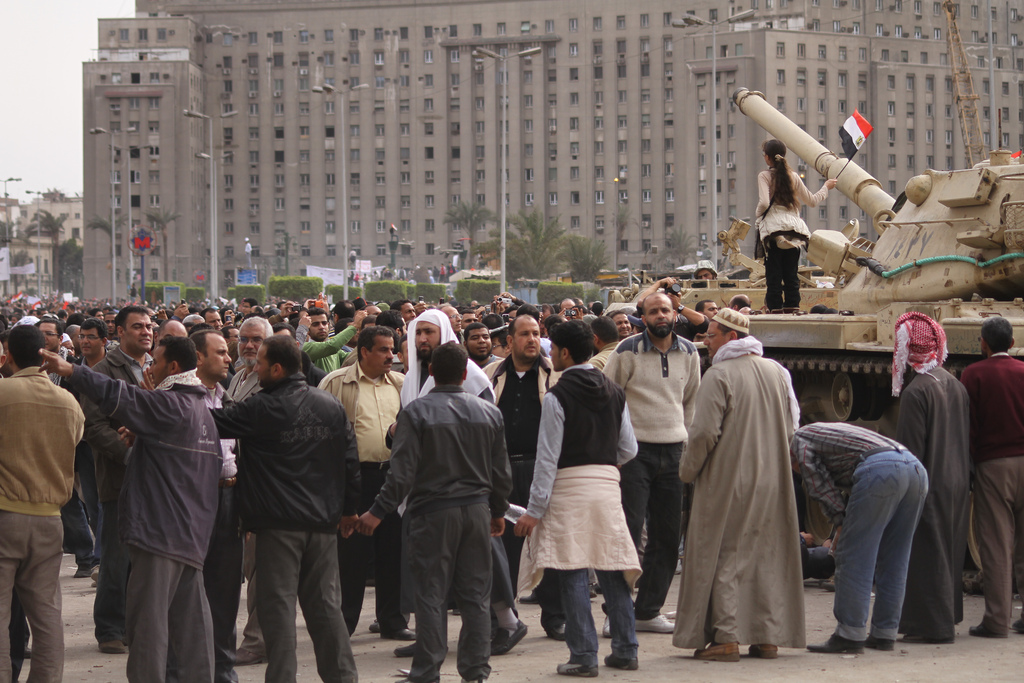
Where have all the leaders gone? So much has happened in 2011, but there is precious little evidence of world events being guided by a few great men and women. From the social revolution in Egypt's Tahrir Square to the impact of the Tea Party on American politics, and on to the Occupy movement, loose-knit, largely leaderless networks are exercising great influence on social and political affairs.
Networks draw their strength in two ways: from the information technologies that connect everybody to everybody else, and from the power of the narratives that draw supporters in and keep them in, sometimes even in the face of brutal repression such as practiced by Bashar al-Assad's regime in Syria. Aside from civil society uprisings, this is true of terrorist networks as well. The very best example is al Qaeda, which has survived the death of Osama bin Laden and is right now surging fighters into Iraq -- where they are already making mischief and will declare victory in the wake of the departure of U.S. forces.
The kind of "people power" now being exercised, which is the big story of the past year, is opening a whole new chapter in human history -- an epic that was supposed to have reached its end with the ultimate triumph of democracy and free market capitalism, according to leading scholar and sometime policymaker Francis Fukuyama. When he first advanced his notion about the "end of history" in 1989, world events seemed to be confirming his insight. The Soviet Union was unraveling, soon to dissolve. Freedom was advancing nearly everywhere. Fukuyama knew there would still be occasional unrest but saw no competing ideas emerging. We would live in an age of mop-up operations, such as the 2003 invasion of Iraq -- for which he had initially plumped -- and this year's war to overthrow Libya's Muammar al-Qaddafi. As Fukuyama noted in his famous essay, "the victory of liberalism has occurred primarily in the realm of ideas or consciousness and is as yet incomplete in the real or material world."
Fukuyama is only the latest in a long line of wise people who thought things were "over." From humankind's historical beginnings, a very lively interest in endings has always been apparent. The unknown author of the epic of Gilgamesh, a ruler of ancient Uruk (modern Iraq), was the first to focus on the mortality of the individual. He explored questions that were picked up on later by Aristotle, Lucretius, and Aurelius -- about the meaning of existence and what happens after death -- and that have continued to puzzle the thoughtful up into our time. Others have looked at "the end" from a wider, world-encompassing perspective -- most dramatically depicted in the "revelations" envisioned by Christian Apocalyptic literature. The Mayans, too, thought very much about endings. Their "long-count" calendar is famously set to terminate on Dec. 21, 2012.
The larger sweep of world events has often been incorporated into these "endist" views as well. Genghis Khan's Mongol hordes, the "Tatars," were so named by Christians who believed that these all-conquering riders had come from the nether world, Tartarus, to announce the looming end of times. Tolstoy's character from War and Peace, Pierre Bezukhov, spent a lot of time and effort attaching numerical values to Napoleon's name -- to see whether the Corsican had the "number of the Beast" (666). Hitler also had his turn in the dock as a candidate anti-Christ. All of them proved false, however, and the end never quite came.
Many have expressed doubts about the latest "end of history" thesis, and even Fukuyama has mused that, even if some kind of inflection point has been reached, history could well continue on in some new vein. In this he might be right. For it is possible -- indeed, more appropriate -- to look at world events from a point of view that considers "endings" as not so final.
Instead there are historical turnings after which what was recedes and what is and will persist flourishes -- a world less driven by the apocalyptic, one more attuned to the epochal. It could be argued that the Bible takes this view: The Flood in Genesis ushers in not the end but a new beginning; the Second Coming in Revelation features travail, but also a 1,000-year era of peace. Even J.R.R. Tolkien's saga of Middle-earth sees "the end" as a new beginning -- as does the Mayan long-count calendar.
So it may be now. But just what is ending? And what is beginning? In terms of world affairs, I see that a great turning has occurred: A process that began in the 16th century reached its climax at the end of the millennium. There was a protracted struggle during this period between empires and the nation-states that rose up, fought against, and eventually defeated them.
Before the start of the long wars between empires and nations -- i.e., for all of recorded history from Sargon of Akkad to Philip II of Spain -- all great events were driven by empires that fed on the territory, resources, and labor of others. Persian, Greek, Roman, Moorish, Ottoman, Mongol, Mughal -- with few exceptions, these and other empires were the arbiters of events. But in the 1500s, a sense of nationalism began to emerge in some places, most notably