Saturday, June 2, 2012

Short Guide to Hell and Back?

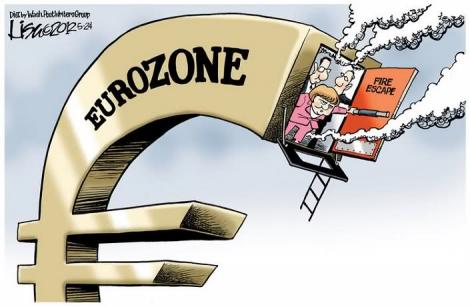
Why A Grexit Would Make Lehman Look Like Childs Play
By Peter Tchir
Maybe I’m wrong, but every time I look at the possibility of a Greek exit right now I see it spiraling out of control and dragging down the entire global economy.  I hear and read the arguments of why it is controllable and they just don’t seem credible.  They either link a Greek devaluation to other devaluations that have little, if anything in common.  They also seem to ignore human nature and how the markets will likely respond.  I think with planning and time, a Greek exit would be manageable but right now it would create chaos, first within Europe and then the globe.
The ECB, EFSF and IMF will take massive losses
The ECB has €50 billion of GGB bonds still on their books.  Those would not get paid at par by Greece if this is an amicable breakup, but this is quickly heading to a pots and pans thrown in the kitchen sort of break-up.  Why would Greece pay the ECB if they feel like the ECB drove them out?  Don’t forget, not for a second, that most of the money Greece now gets goes to pay back the ECB and IMF.  The EFSF is totally out of luck.  The ECB might be able to offer something to a post drachma Greece, but the EFSF offers nothing.  The IMF has more negotiating power, as their direct loans had more protection in the first place and they are likely to provide additional funds post exit, but quite simply Greece won’t be able to pay them in full on existing loans.

We are not all destined for greatness

Murray Rothbard was one of them
by Gary North
I received my Ph.D. in history. My specialty was colonial America. Yet when I pull down a copy of one of Murray Rothbard's four-volume history of colonial America, Conceived in Liberty, to do a little "light" reading, I am always astonished. Page after page will relate incidents I have never heard of.
Now it's in one fat volume.
Rothbard wrote this book as a side venture. He was an economist by training, with a mathematics minor as an undergraduate. He had zero formal training as a colonial American historian.
How did he do it? Prof. Richard Ebeling provides insights. This is from a May 1, 2012 email.
"Roy Childs told me that once when he was visiting and staying with Murray and Joey in their New York apartment, Murray and he were in the living room, each reading a book.
Roy noticed that Murray seemed to be rapidly scanning and turning the pages of the book in his hands. He asked Murray how he could understand and remember anything going through a book that quickly?

Is the Deadly Kissing Bug Disease the New HIV/AIDS?

We 'll find out
By David DiSalvo
Chagas, a disease caused by a parasite transmitted via the Triatoma bug (aka, the kissing bug), is claiming thousands of lives in Central and South America.  Some experts are even calling it the “new HIV/AIDS of the Americas.  But is this comparison accurate, and how big a threat is the disease to the US?
Chagas is not a new disease. It’s named after Carlos Chagas (circa 1909), a Brazilian doctor who discovered that Triatoma carry a potentially lethal parasite called Trypanosoma cruzi. After several of his patients developed a strange infection that he couldn’t identify, Chagas set out to investigate how humans come in contact with the pathogen and its effects on the body of its host.  He probably didn’t realize at the time that his work was groundbreaking in the history of epidemiology (Chagas later went on to identify the parasitic fungal genus Pneumocystis, another major discovery).
Kissing bugs, named because they bite the face and lips of humans (they’re also called assassin bugs), live in tropical climates near warm-blooded vertebrates to gain easy access to their blood.  They stay hidden for much of the day, living in concealed places such as the cracks in a piece of wood and thatched roofs, and usually strike their victims as they sleep.  The bugs defecate as they feed, allowing the parasite they carry to infect a new host.

The placebo of currency devaluation

Thoughts on the Greek crisis and the politicization of economics
by DETLEV SCHLICHTER
Should the Greeks have a referendum on whether they want to stay in the euro? Are the upcoming elections such a referendum? Would it be better for the Greeks if they left the euro? – Are you, like me, sick and tired of hearing these questions and then the answers based on the same stale and superficial logic?
Most commentators assume that it was a mistake of ‘the Greeks’ to enter European Monetary Union and that they would do better outside of it. I suspect some undue generalization behind such verdicts. For who do these observers talk about when they say ‘the Greeks’? It seems evident, for example, that to the extent that the Greeks are savers they do not believe that exiting the euro and having again a depreciating local currency is in their interest. In fact, they expect to get hurt by such a move. These savers – the forgotten men and women of the crisis – are already holding their own referendum. They are shipping their savings to Germany, the Netherlands and Finland in an attempt to protect them from confiscation through devaluation and inflation. They want their savings to stay in the Euro Zone. Such ‘voting’ could be characterized as ‘Germanic’, although I would say it simply serves to show that the interests of those who save are very similar, regardless of which country’s passport they hold.

U.S., Europe on different paths to same place

Defying not just the rules of economic gravity but the basic human life cycle


by Mark Steyn
The Eurovision Song Contest doesn't get a lot of attention in the United States, but on the Continent it's long been seen as the perfect Euro-metaphor. Years before the euro came along, it was the prototype pan-European institution and predicated on the same assumptions. Eurovision took the national cultures that produced Mozart, Vivaldi and Debussy, and in return gave us "Boom-Bang-A-Bang" (winner, 1969), "Ding-Ding-A-Dong" (winner, 1975) and "Diggi-Loo-Diggi-Ley" (winner, 1984). The euro took the mark, the lira and the franc, and merged them to create the "Boom-Bang-A-Bang" of currencies.
How will it all end? One recalls the 1990 Eurovision finals in Zagreb: "Yugoslavia is very much like an orchestra," cooed the hostess, Helga Vlahović. "The string section and the wood section all sit together." Shortly thereafter, the wood section began ethnically cleansing the dressing rooms, while the string section rampaged through the brass section pillaging their instruments and severing their genitals. Indeed, the charming Miss Vlahović herself was forced into a sudden career shift and spent the next few years as Croatian TV's head of "war information" programming.

Radically Lower the Cost Basis of the Entire Economy

Our choice is simple
Either continue on the State-cartel path of complexity and rising costs that leads to a death spiral, or re-energize the forces of the market and community. 
By Charles Smith
We are constantly told all our problems are too complex to be addressed with simple "big idea" solutions. Complex problems require complex solutions, we are assured, and so the "solutions" conjured by the Central State/Cartel Status Quo are so convoluted and complex (for example, the 2,319-page Dodd-Frank Wall Street Reform and Consumer Protection Act or the 2,074-page Obamacare bill) that legislators say they must "pass the bill to see what's in it." (What If We're Beyond Mere Policy Tweaks? February 6, 2012)
The real "solution" is to see that complexity itself is the roadblock to radical reformation of failed systems. Complexity is the subterfuge the Status Quo uses to erect simulacra "reforms" while further consolidating their power behind the artificial moat of complexity.
Nature is complex, but it operates according to a set of relatively simple rules. The interactions can be complex but the guiding principles can be, and indeed, must be, simple.
Big Idea One: Radically lower the cost basis of the entire U.S. economy. The cost basis of any activity is self-evident: what are the total costs of the production of a good or service? The surplus produced is the net profit which can be spent on consumption or invested in productive assets (or squandered in mal-investments).

New Yorkers Leave Like East Germans Fled Communism

New Yorkers' choice is a wrenching one
IBD Editorial
New York thinks of itself as the place to be, but its high taxes have made it a place to flee. Those who have escaped the Empire State tax man could fill a major city.
From 1949 to 1961, more than 2.6 million of East Germany's 17 million population escaped to West Berlin or West Germany, a hemorrhage of humanity that led the Communists to construct the infamous Berlin Wall in 1961.
The state of New York, with about 19.5 million people, has no known plans to erect concrete barriers or barbed wire fences. But from 2000 to 2010 it suffered an exodus of some 3.4 million New Yorkers — nearly a million more people than in Germany's post-war experience and more than that of any other state.
And the outflow hasn't stopped. The income loss for the state is $45.6 billion, the Tax Foundation says.

Nuclear Tuna Is Hot News, But Not Because It's Going To Make You Sick

Tuna and Bullshit
by RICHARD HARRIS
What snarky headline writer could resist a story about "hot tuna?" Or how about "tuna meltdown?"
Really, it seems just plain daffy to ignore a new study that says some Pacific bluefin tuna picked up traces of radioactive material from the Fukushima nuclear disaster last year and brought it across the Pacific Ocean.
And while, as a rule, we avoid making light of nuclear disasters, the tuna story is actually just plain curious, rather than threatening, once you understand the context.
You see, Pacific bluefin tuna spawn off the coast of Japan. They are superb swimmers, so in a few months time, they make it across the Pacific to the coast of Mexico and Southern California to feed — and then get caught. They are also delicious, pricey and on the verge of population collapse, according to Monterey Bay Aquarium Seafood Watch.
Last summer, scientists bought 15 of these beautiful fish from the docks in San Diego to check them for contaminants.

Why Bonn Is Not Athens

A walk through central Athens
By Victor Davis Hanson
This week I am leading a military-history tour on the Rhine River from Basel, Switzerland, to Amsterdam. You can learn a lot about Europe’s current economic crises by ignoring the sophisticated barrage of news analysis and instead just watching, listening, and talking to people as you go down river.
Switzerland, by modern standards, should be poor. Like Bolivia, it is landlocked. Like Italy, it has no real gas or oil wealth. Like Afghanistan, its northern climate and mountainous terrain limit agricultural productivity to upland plains. And like Turkey, it is not a part of the European Union.
Unlike Americans, the Swiss are among the most homogeneous people in the world, without much diversity, and they make it nearly impossible to immigrate to their country.
So Switzerland supposedly has everything going against it, and yet it is one of the wealthiest nations in the world. Why and how? 

A Stasi for America

A History of the FBI
By JAMES BOVARD
A ripple of protest swept across the Internet in late March after the disclosure that the Federal Bureau of Investigation was teaching its agents that “the FBI has the ability to bend or suspend the law to impinge on the freedom of others.” This maxim was inculcated as part of FBI counterterrorism training. The exposure of the training material—sparked by a series of articles by Wired.com’s Spencer Ackerman—spurred the ritual declaration by an FBI spokesman that “mistakes were made, and we are correcting those mistakes.” No FBI officials were sanctioned or fired for teaching lawmen that they were above the law.
At least the FBI has been consistent. Since its founding in 1908, the bureau has rarely let either the statute book or the Constitution impede its public service. Tim Weiner, the author of a superb exposé of the CIA (Legacy of Ashes) has delivered a riveting chronology of some of the FBI’s biggest crimes with his new book, Enemies.

The Harm in Hate-Speech Laws

Eliminating Dissent
by David Gordon
In many countries, though not in the United States, laws prohibit "hate speech." Those who, in Jeremy Waldron's opinion, uncritically elevate the benefits of free speech over competing values oppose hate-speech laws; but Waldron thinks that a strong case can be made in their favor. (Waldron thinks that there are "very few First Amendment Absolutists" [p. 144] who oppose all regulation of speech; but he thinks that many other First Amendment scholars are unduly critical of hate speech regulations.) Waldron is a distinguished legal and political philosopher, but the arguments that he advances in defense of hate-speech laws, taken on their own terms, do not seem to me very substantial.[1]

Property Means Preservation

Government's good intentions have done little to protect endangered wildlife
by Doug French
To the minds of most environmentalists, the ham-hand of government is needed to protect wildlife. Private property be damned — the government must step in, otherwise every species on the planet will be hunted into oblivion, or human development will gobble up all remaining wildlife habitat, leading to the complete extinction of all species.
However, on the African plain it's just the opposite. From the van leaving Hoedspruit airport to the Thornybush Game Preserve, we saw nothing but mile after mile of African savannah, enclosed in electrified fencing (and at one point an ape bounding across the road). Although government-owned Kruger National Park is nearby, the area is dominated by private game reserves, with ecotourism being the primary driver of the local economy.

Grexit? Spexit? Let's Call the Whole Thing Off

Everyone wants southern Europe's troubled economies to go their own way, except for the people who live there
BY EDWARD HUGH
One thing we've learned as the euro crisis has unfolded is that the enthusiasm of experts in London and New York for offering advice to the struggling countries on Europe's periphery is matched only by their passion for awkward neologisms. The world was just getting used to "Grexit" (Get it? A Greek exit from the euro!) when "Spexit" began to rear its ugly head in the financial press.
Naturally, the events of recent days have brought Spain back to the forefront of the debt crisis, generating insecurity about the reliability of the official fiscal deficit numbers, the validity of central bank statistics, and new numbers showing capital flight reaching alarming levels. Only this week, Spain announced that the central bank governor, Miguel Angel Fernandez Ordoñez, will be leaving early as part of a government effort to restore its credibility. Some are now anticipating that Spain's exit from the eurozone will come before Greece's departure.

Friday, June 1, 2012

America’s new Age of Austerity starts now

Denials, delays will deepen the impact
" ... tighten your belts, America’s new Age of Austerity is already here, today. There I said it. I admit it. And you better too. Prepare now. Could be like the 1930s depression austerity."
By PAUL B. FARRELL
You’ve seen the warnings all across the major newspapers about a global slowdown. But why no warnings of austerity dead ahead? Why? America’s still deep in denial. We prefer happy talk to the truth. No, nobody will get honest about austerity till after the elections. Then it’ll hit hard. 
Wake up. You were warned: America’s new Age of Austerity is already here.
Till the elections, nobody else will tell you the truth about what comes with this slowdown: Plan on classic economic austerity. Maybe not austerity as deep as the euro zone’s Spain and Greece. Yet maybe deeper than the 1930s as Nobel economist Paul Krugman writes in his new book, “End This Depression Now.”
Yes, America’s already in a depression. Wake up America, to a long bear market, a recession cycle, to austerity where everything slows down, income, jobs, retail, global trade, and market returns. Listen to the latest warnings just last week:

Did Turkey win the war in Iraq?

Turkey, Kurdistan and the future of Iraq
By John Hannah
With last week's headlines dominated by Egypt's presidential elections, negotiations on Iran's nuclear program, and fresh atrocities in Syria, it would have been easy to miss a major development out of Iraq that in time could have equally momentous consequences for the future of the Middle East. I'm referring to the announcement that the Kurdistan Regional Government (KRG) and Turkey have agreed -- in principle at least -- to build a series of pipelines that will allow the Kurds to export oil and gas directly to Turkey and, from there, onward to the rest of the world. The U.S. should be paying close attention.
Until now, the KRG's ability to develop its substantial energy riches has been held hostage to its dependence on export pipelines controlled by the central government in Baghdad. To get any oil to international markets -- and, in turn, to get its fair share of revenue from those sales -- the KRG has largely been at Baghdad's mercies.

Tuesday Never Comes

An Ocean of Credit

By William H. Gross
The global economy is floating on an ocean of credit, and a good thing too as our cartoon friend Wimpy reminds us. Without it, he would be a hungry puppy by next Tuesday and nearly seven billion world citizens would be worse off if barter, and not credit, was the oil that lubricated trade. Unlike Wimpy, early societies functioned without an exchange of (money) or the promise to pay it back in the future (credit). Growth was limited, however, because savings or investment could not be incented properly.
Those that wanted to save for a rainy day had no means to express that caution; better to consume a banana or a hamburger today than to watch it rot and become worthless on Tuesday. But money changed all of that and the ability to borrow and exchange it for repayment at some future date was the economic elixir of the ages. Shakespeare, with his admonition to “neither a borrower nor a lender be,” might have won a 17th century Pulitzer, but definitely not a Nobel Prize for economics.
Still, the use of credit never really kicked into high gear until the discovery of fractional reserve banking and the ultimate formation of central banks to facilitate and protect its disbursement. 

Spain cries for help

Is Berlin listening ?
By Michael Stott
Crisis is the watchword in Madrid. Take your pick - liquidity crisis, debt crisis, banking crisis, economic crisis, confidence crisis, investor crisis, jobless crisis. Spain, the ailing euro zone's latest problem child, has them all.

As the problems pile up, Prime Minister Mariano Rajoy's five-month-old conservative administration feels like a government under siege. Nervy top officials are reluctant to speak on the record for fear of slipping up. Policymakers contradict one another. Plans keep changing. Financial markets reel amid the uncertainty. The gloom in ministry corridors is palpable.

The latest gaffe: after weeks insisting that one of the country's biggest banks, Bankia, did not need fresh funds, ministers dropped the bombshell last Friday that there was a 23-billion-euro hole in the accounts. They have yet to explain clearly how they will find the money when they are already struggling to finance a spiraling national debt.


Bad Sports

The unreasonable economics of the London Olympics
By DALIBOR ROHAC AND HEMAL SHAH
Before the 1948 Olympic Games in London, an Evening Standard editorial suggested that “the average range of enthusiasm for the games stretches from lukewarm to dislike. It is not too late for the invitations to be politely withdrawn.” This year, as London prepares to host another Olympics—“the greatest Games that have ever been held,” London mayor Boris Johnson promises—canceling the event isn’t an option. And that’s unfortunate, because a sober look suggests that not much has changed since 1948. What was arguably a waste of money in the cash-strapped years after the Second World War will be a waste of money again in fiscally messy 2012.

The Monster Has Awakened

Brussels issues a War Declaration
"I was answered through the stillness of night by a loud and fiendish laugh. It rang on my ears long and heavily; the mountains re-echoed it, and I felt as if all Hell surrounded me with mockery and laughter."
                                               -Mary Shelley, Frankenstein
by Mark J. Grant

The most significant event of yesterday was not the Spanish banking system unlocking the door to the horror chamber and clicking the melt-down button that it found on the wall but what happened at the European Union. That which had been created woke and in its new found consciousness sat upright and staring into the void it turned upon its Master. It should not have come as a surprise, I suppose, but the mockery of the beast was a frightening sight.

For thirteen years the nations of Europe had worked, slaved, propped up their egos with their ministrations and yesterday the Creation came into its own mind and threw off the shackles in which it had been bound and leapt up upon the table and announced that it no longer belonged to any man and that the chains that had held it would not enslave it any longer. Brussels turned, and looking Berlin squarely in the eye, it used impolite words and gestures and essentially said:
"Stick it."

Are You Ready?

Europe Is About to Implode... 
By Graham Summers
I've warned time and again that the EU would collapse in May-June. That collapse is here right on schedule. And NO ONE will be able to stop it.
Here's why:
1) According to the IMF, European banks as a whole are leveraged at 26 to 1 (this data point is based on reported loans... the real leverage levels are much, much higher.) These are a Lehman Brothers leverage levels.
2) The European Banking system is over $46 trillion in size (nearly 3X total EU GDP).

It's Not Our World

The World America Made
By Mark Steyn
There is a great deal of ruin in a nation, and even more of it in the nation's publishing catalogue. Robert Kagan has noticed the resurgence of declinism; he doesn't care for it; and The World America Made is his response to it. For the record, I am not a declinist: I'm way beyond that, and am more of a collapsist, as may be adjudged from the title of my own contribution to the genre, After America, and even more from its subtitle, "Get Ready for Armageddon." As I'm always at pains to point out, an author doesn't get into the apocalyptic doom-mongering biz because he wants it to happen. As anyone who's tried enforcing his copyright in China or the old Soviet Union or your average nickel-'n'-dime Third World basket case well knows, in a world without Western civilization the royalty checks are going to be a lot smaller. So you write the head-for-the-hills stuff in hopes of preventing the need to.

Debt, Austerity and Recovery

Debt, the enemy of growth
By Robert Huebscher
Global economies are experiencing unsustainable debt disequilibrium, according to Lacy Hunt.   Economic textbooks preach that equilibrium, rather than transition, should be the predominant condition.   But our attempts to reduce our indebtedness by taking on more – and less productive – debt are weakening our economy and creating unstable conditions.
“If we take on debt, either in the private sector or indirectly in the government sector, to finance current consumption, the net result is that we will make the economy weaker and weaker,” Hunt said. “That is basically the path that we are on.”

The Truth About Europe

There Is No Solution
By Raul Ilargi Mendoz
I like that title, The Truth About Europe: There Is No Solution. But I don't think it can all be summed up, the reasons why I mean, in one article. So I think I'll make it a running series. Still, whatever data we can look at, past, present and future, none of it will make an essential difference. The title stands: There Is No Solution For Europe. Period.
All I can do is keep pointing to news and stats and data that confirm that. All of them do, so that should make it a lot easier, even if most voices out there never tire from pointing out the opposite.
Nor do I need to limit my topic to Europe; it's not as if the US, or Australia, or any other industrialized country, has any other fate to look forward to. This global debt deflation is truly global, the only thing that differs is the exact time the hammer comes down. Maybe those people are best off who never had much, though they will be sure to be squeezed ever harder by us, the declining rich.

Thursday, May 31, 2012

Wall Street Food Chain

Plankton Disappearing, Food Chain at Risk
By William H. Gross
The whales of our current economic society swim mainly in financial market oceans. Innovators such as Jobs and Gates are as rare within the privileged 1% as giant squid are to sharks, because the 1% feed primarily off of money, not invention. They would have you believe that stocks, bonds and real estate move higher because of their wisdom, when in fact, prices float on an ocean of credit, a sea in which all fish and mammals are now increasingly at risk because of high debt and its delevering consequences. Still, as the system delevers, there are winners and losers, a Wall Street food chain in effect.
These economic and/or financial food chains depend on lots of little fishes in the sea for their longevity. Decades ago, one of my first Investment Outlooks introduced “The Plankton Theory” which hypothesized that the mighty whale depends on the lowly plankton for its survival. The same applies in my view to Wall, or even Main Street. When examining the well-known wealth distribution triangle of land/labor/capital, the Wall Street food chain segregates capital between the haves and have-nots: The Fed and its member banks are the metaphorical whales, the small investors earning .01% on their money market funds are the plankton. Yet similar comparisons can be drawn between capital and labor

6 reasons Spain will leave the euro first

Spain is too big to rescue, and doesn’t want it anyway
By MATTHEW LYNN
The euro debt crisis, like any really spectacular geoeconomic event, is spawning its own special vocabulary.
We’ve already had Merkozy, now relegated to the footnotes, and are slowly getting used to the clunkier Merlande or Merkellande, as the oddly matched pairing of the German Chancellor Angela Merkel and the French President Francois Hollande has been dubbed. The Grexit, short for Greece finally giving up on the single currency, has been trending for the last few weeks. And coming up next: the Spexit.
What’s that? It’s shorthand for Spain quitting the euro — and we’re going to hear a lot of it over what promises to be a turbulent summer.
The Spanish are a lot more likely to pull out of the euro than the Greeks, or indeed any of the peripheral countries. They are too big to rescue, they have no political hang-ups about rupturing their relations with the European Union, they are already fed up with austerity, and there is a bigger Spanish-speaking world for them to grow into. There are few good reasons for the country to stay in the euro — and little sign it has the will to endure the sacrifices the currency will demand of them.

No one has any idea what will happen next

On Europe: "A Willing Lender Of Last Resort May Not Be Enough"
It is becoming clearer and clearer that some new policy option is required in Europe - but as JPMorgan's Michael Cembalest excellent cartoon description of the never-ending circular arguments among European leaders would put it - you would have to be a wide-eyed optimist to believe it will be a decisive one. Comparing the progress of the European Monetary Union with structural changes in the US around the end of the 19th century, it is arguable that more time is needed before judgment is passed but they may not get the chance.
The resolution of a staggering EUR10 trillion in peripheral sovereign, household, and corporate debt may not wait. Durable unions are signaled by signs of wage convergence and unilateral transfers of wealth to smooth regional income difference - while a lender of last resort appears to be most people's solution, it likely will not be enough given the competitive divergences.
"How long can this farce go on? It feels like a new policy option is needed (particularly in Spain, which looks terrible), but you would have to be a wide-eyed optimist to believe it will be a decisive one. Over the weekend, I reread an influential paper from the 1949 US Quarterly Journal of Economics which looked at how the US survived the Great Depression. A critical factor: US regional transfers undertaken by the US Treasury which were unilateral in nature, akin to a capital movement, a gift or an indemnity in international trade”.

Green Requiem

Spain Ejects Clean-Power Industry 
By Alex Morales and Ben Sills
Spanish renewable-energy companies that once got Europe’s biggest subsidies are deserting the nation after the government shut off aid, pushing project developers and equipment-makers to work abroad or perish.
From wind-turbine maker Gamesa Corp. Tecnologica SA (GAM) to solar park developer T-Solar Global SA, companies are locked out of their home market for new business. These are the same suppliers that spearheaded more than $69 billion of wind and solar projects since 2004 that today supply more than 50 percent of Spain’s power demand on the most breezy and sunny days.
Saddled with a budget deficit more than twice the European Union limit and a ballooning gap between income and costs in its power system, Spain halted subsidies for new renewable-energy projects in January. The surprise move by Prime Minister Mariano Rajoy one month after taking office helped pierce investor confidence in stable aid for clean energy across Europe.

Rockefellers and Rothschilds unite

172 years of combined experience 
By Daniel Schäfer
Two of the best-known business dynasties in Europe and the US will come together after Lord Jacob Rothschild’s listed investment trust and Rockefeller Financial Services agreed to form a strategic partnership.
RIT Capital Partners is to buy a 37 per cent stake in the Rockefeller’s wealth advisory and asset management group for an undisclosed sum, giving Lord Rothschild’s London-listed trust a much sought-after foothold in the US.
The transatlantic union brings together David Rockefeller, 96, and Lord Rothschild, 76 – two family patriarchs whose personal relationship spans five decades.
The Rockefeller group traces its roots back to 1882 when John D. Rockefeller established one of the world’s first family offices dedicated to investing his wealth. It has since developed into a provider of wealth and asset management services to other families, foundations and institutions. It is majority-owned by the 19th century oil magnate’s family and has $34bn of assets under administration.
The partnership with RIT will focus on setting up investment funds, eyeing joint acquisitions of wealth and asset managers and granting each other non-executive directorships.

U.S.A. 2012. A nation of liars and thieves.

Is This What We've Become?
"Incentivize victimhood, fraudulent accounting of income/collateral and gaming the system, and guess what you get? A nation of liars and thieves"
By Charles Smith
Memorial Day is traditionally a day to speak of sacrifices made in combat. Like much of the rest of life in America, it has largely become artificial, a hurried "celebration" of frenzied Memorial Day marketing that is quickly forgotten the next day.
Instead of participating in this rote (and thus insincere) "thank you for your sacrifice" pantomime, perhaps we should ask what else has been sacrificed in America without our acknowledgement. Perhaps we should look at the sacrifices that need to be made but which are cast aside in our mad rush to secure "what we deserve."
The unvarnished reality is that most Americans have no idea what service members experienced in Iraq and Afghanistan, and they don't want to know. When 4,488 white crosses were erected on a hillside to remind us of all those who made the ultimate sacrifice in Iraq, people didn't like it, labeling it "unpatriotic."

Wednesday, May 30, 2012

Why The ECB Will Print

Never underestimate a desperate central bank’s willingness to print

By Jeff Harding
There is a lot of chatter about the eurozone, Greece, Spain, Germany, and the European Central Bank (ECB). And rightly so since we appear to be reaching a critical stage there. Some have raised the point that there is nothing the ECB can do to solve their problems. That is correct in the long run. But in the short run, never underestimate a desperate central bank’s willingness to print.
This morning I was referred to an article from Phoenix Capital Research that posited that “THERE IS NO ENTITY ON EARTH THAT CAN BAILOUT EUROPE.” I suggest you read it; it’s not long. It shows the complexity of the situation for a system that was born to fail. Phoenix has another article today on this topic on their web site. 
Their first point was:

Why Moral “Don’ts” Matter Most

Social harmony is directly related to the existence of clear standards for behavior
By David C. Rose
How important are moral values for the development and operation of a free-market economy? What follows is an explanation for why some moral values—the moral “don’ts”—are important to the conduct of economic activity, while other moral values—the moral “do’s”—can actually act as impediments. This distinction was first proposed in my book, The Moral Foundation of Economic Behavior. An interesting byproduct of this exercise is that it sheds light on what a moral framework that comports with libertarianism might look like.
“Moral do’s” are exhortations that tell us what to do if we are to be moral. Since the positive moral action they encourage is often a matter of degree, they tend not to be specific. For example, the moral exhortation “be generous” may induce you to give a beggar money, but it does not tell you how much to give in any given circumstance. Moral exhortations leave unanswered the question of how generous is generous enough to be moral. There are different degrees of generosity, and what you might think is appropriately generous in a given circumstance I might find inadequate.