Monday, September 24, 2012

Dead Country Keeps Walking - Backwards

Greece Caught Under-reporting Its Budget Deficit By Nearly 50%
by Tyler Durden
There was a time about a year ago, before the second Greek bailout was formalized and the haircut on its domestic-law private sector bonds (first 50%, ultimately 80%, soon to be 100%) was yet to be documented, when it was in Greece's interest to misrepresent its economy as being worse than it was in reality. Things got so bad that the former head of the Greek Statistics Bureau Elstat, also a former IMF employee, faced life in prison if convicted of doing precisely this.
A year later, the tables have turned, now that Germany is virtually convinced that Europe can pull a Lehman and let Greece leave the Eurozone, and is merely looking for a pretext to sever all ties with the country, whose only benefit for Europe is to be a seller of islands at Blue Aegean water Special prices to assorted Goldman bankers (at least until it renationalizes them back in a few short years). So a year later we are back to a more normal data fudging dynamic, one in which Greece, whose July unemployment soared by one whole percentage point, will do everything in its power to underrepresent its soaring budget deficit.

Sunday, September 23, 2012

The Next Industrial Revolution

Large, centrally-directed systems are inherently fragile
by John Aziz
Think of the human body; a spontaneous, unexpected blow to the head can kill an otherwise healthy creature; all the healthy cells and tissue in the legs, arms, torso and so forth killed through dependency on the brain’s functionality. Interdependent systems are only ever as strong as their weakest critical link, and very often a critical link can fail through nothing more than bad luck.
Yet the human body does not exist in isolation. Humans as a species are a decentralised network. Each individual may be in himself or herself a fragile, interdependent system, but the wider network of humanity is a robust independent system. One group of humans may die in an avalanche or drown at sea, but their death does not affect the survival of the wider population. The human genome has survived plagues, volcanoes, hurricanes, asteroid impacts and so on through its decentralisation.

When Politicians Feel Voters' Infantilism

Someday, someone is going to seek the presidency by demystifying it


By GEORGE F. WILL
In every year divisible by four, the dominant superstition of American politics — faith in the magic of presidential words and deeds — reaches an apogee that feeds national narcissism: Everything that happens anywhere is about us, is a response to something America did or did not do, and can be controlled by a president doing — even just saying — something.
This self-absorption was evident as Mitt Romney and the Obama administration sparred about violence directed at U.S. facilities in the Middle East and elsewhere.
Romney called this the fruit of administration weakness; the administration blamed it on a video. It would require exquisitely precise intellectual calipers to gauge which idea is silliest.
In Egypt, Libya and elsewhere, the crumbling of old regimes and hierarchies has ignited complex sectarian and tribal power struggles, in which some participants find anti-Americanism useful.

Germany's Wind Power Chaos Should Be A Warning To Everyone

Germany’s renewables drive is turning out to be a disaster


By Christopher Booker
On Friday, September 14, just before 10am, Britain’s 3,500 wind turbines broke all records by briefly supplying just over four gigawatts (GW) of electricity to the national grid. Three hours later, in Germany, that country’s 23,000 wind turbines and millions of solar panels similarly achieved an unprecedented output of 31GW. But the responses to these events in the two countries could not have been in starker contrast.
In Britain, the wind industry proclaimed a triumph. Maria McCaffery, the CEO of RenewableUK, crowed that “this record high shows that wind energy is providing a reliable, secure supply of electricity to an ever-growing number of British homes and businesses” and that “this bountiful free resource will help drive down energy bills”. But in Germany, the news was greeted with dismay, for reasons which merit serious attention here in Britain.

The Republic has no need of geniuses

Trivia: Father of Modern Chemistry Beheaded in French Revolution
By Alex
Antoine Lavoisier, the Father of Modern Chemistry, was beheaded during the French Revolution.
An appeal to spare his life was cut short by the judge, who said: "The Republic has no need of geniuses."

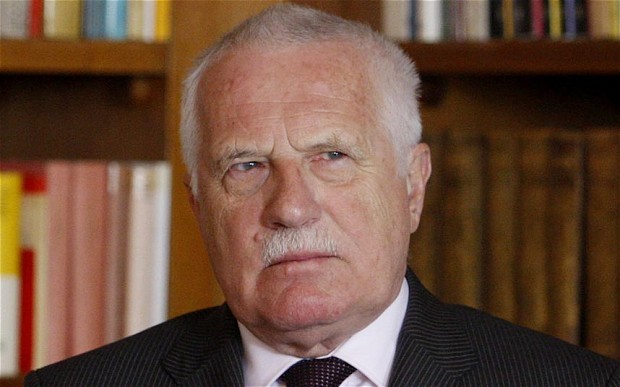
Václav Klaus warns that the destruction of Europe's democracy may be in its final phase

'Two-faced' politicians have opened the door to an EU superstate by giving up on democracy
By Bruno Waterfield
The new push for a European Union federation, complete with its own head of state and army, is the "final phase" of the destruction of democracy and the nation state, the president of the Czech Republic has warned.
In an interview with The Sunday Telegraph, Václav Klaus warns that "two-faced" politicians, including the Conservatives, have opened the door to an EU superstate by giving up on democracy, in a flight from accountability and responsibility to their voters.
"We need to think about how to restore our statehood and our sovereignty. That is impossible in a federation. The EU should move in an opposite direction," he said.

“The Economy” and the Taxpayer

A “soft” servitude
by Joseph Sobran
“Would a tax cut be good for the economy?” Economists are having their usual eye-glazing debate over this question, without bothering to define their terms. The Bush administration wants to cut taxes a little tiny bit over the next decade, insisting it will help “the economy”; their opponents say that even a little tiny tax cut could hurt “the economy.”
What do they mean by the economy? Is it a single thing, or a whole lot of disparate things lumped together into a misleading abstraction?
The first thing to notice is that Americans didn’t use to talk this way. In the first century of the U.S. Government’s existence, when Federal budgets were in the millions, not trillions, taxes were very low, the country prospered as no other country had, individual freedom was unprecedented, and Europeans flocked here. There was no welfare state; the immigrants didn’t come to live off the taxpayer, but to reap rewards for their own efforts in a system of free exchange. Nobody spoke of a monolithic “economy” as the government’s concern.

A totalitarian state in the making

2 U.S. Supreme Court Justices Warn of Dictatorship


by George Washington
Former Supreme Court Justice David Souter told University of New Hampshire School of Law that the “pervasive civic ignorance” in the U.S. could bring dictatorship:
I don’t worry about our losing a republican government in the United States because I’m afraid of a foreign invasion. I don’t worry about it because of a coup by the military, as has happened in some other places. What I worry about is that when problems are not addressed people will not know who is responsible, and when the problems get bad enough — as they might do for example with another serious terrorist attack, as they might do with another financial meltdown — some one person will come forward and say:  ‘Give me total power and I will solve this problem.’
That is how the Roman republic fell.  Augustus became emperor not because he arrested the Roman senate. He became emperor because he promised that he would solve problems that were not being solved.
Former Supreme Court justice Sandra Day O’Connor has also warned of dictatorship.

Myth and Truth About Libertarianism

A plain look at liberty 


by Murray N. Rothbard 
Myths
Libertarianism is the fastest growing political creed in America today. Before judging and evaluating libertarianism, it is vitally important to find out precisely what that doctrine is, and, more particularly, what it is not. It is especially important to clear up a number of misconceptions about libertarianism that are held by most people, and particularly by conservatives. In this essay I shall enumerate and critically analyze the most common myths that are held about libertarianism. When these are cleared away, people will then be able to discuss libertarianism free of egregious myths and misconceptions, and to deal with it as it should be on its very own merits or demerits.
Myth #1: Libertarians believe that each individual is an isolated, hermetically sealed atom, acting in a vacuum without influencing each other.

Pleasing Lucifer

The ‘Faustian pact'


By Jan Skoyles
Faust Part 2 by Goethe includes a cautionary tale on money printing replacing gold with ultimately dire consequences - alluded to recently by Jens Weidmann. Could this be a warning to all Central Bankers?
Bundesbank President and economist, Jens Weidmann, hasn't exactly kept quiet about his lack of support for the ECB bond-buying program. But this week he put it into a context which the public would be able to understand, and ‘shocked' Europeans by relating the program to that of making a deal with the devil.
Weidmann refers, as many have before him, to the ‘Faustian pact', called so thanks to Act I, Part II of Goethe's 1832 play ‘Faust'. In the play the Devil, Mephisto, convinces the Holy Roman Emperor to print large amounts of paper money rather than use gold.  In the short term, the money printing solves the emperor's financial problems, but it soon leads to rampant inflation.

Obama fights for power of indefinite military detention

Obama fights for power of indefinite military detention
Obama lawyers file a breathless, angry appeal against the court ruling that invalidated the NDAA's chilling 2011 detention law
By Glenn Greenwald
In May, something extremely rare happened: a federal court applied the US constitution to impose some limits on the powers of the president. That happened when federal district court judge Katherine Forrest of the southern district of New York, an Obama appointee, preliminarily barred enforcement of the National Defense Authorization Act (NDAA), the statute enacted by Congress in December 2011 with broad bipartisan support and signed into law by President Obama (after he had threatened to veto it).
That 2011 law expressly grants the president the power to indefinitely detain in military custody not only accused terrorists, but also their supporters, all without charges or trial. It does so by empowering the president to indefinitely detain not only al-Qaida members, but also members of so-called "associated forces", as well as anyone found to "substantially support" such forces – whatever those terms might mean. I wrote about that decision and the background to this case when it was issued.

Saturday, September 22, 2012

Hats and tails

The victims of crime are most often of the same class as the criminals themselves
By Theodore Dalrymple
The left, said Le Monde on 31 August, has always been ill at ease with law and order. This is not quite true: the left is only ill at ease in what it calls bourgeois democracies. In people's democracies it has felt no qualms at all about order, though perhaps law is another thing.
Why this illness at ease? The left claims a special vocation to defend the helpless and the underdog, wherever he might be, and criminals are mainly drawn from the impoverished (even if nowadays impoverishment is only relative). Their homes are what, only forty years ago, would have been called broken homes - the statistically normal pattern now, at least in their social class. They are poorly educated and their economic prospects are grim. To heap punishment upon them for the 'natural' consequences of their life experiences seems cruel and unfeeling.
However, this illness at ease is not quite as generous as it might appear. In the first place, it ascribes to the criminals themselves no choice in their own behaviour, as if they were 'you blocks, you stones, you worse than senseless things.‘ In the second place, it makes a certain kind of person - all those with similar experiences - criminal ex officio, as it were. This is demeaning to the many who are not criminal.

The Seven Deadly Sins of John Brennan

What the high priest of targeted killings doesn't want you to know

BY MICAH ZENKO
Last week, I introduced readers to John Brennan, the U.S. president's closest advisor for intelligence and counterterrorism issues. Although Americans know little about Brennan, he plays an essential role in shaping and implementing the expansive, unprecedented targeted killing of suspected terrorists and militants. He is, the New York Times reported, citing administration officials, the "priest whose blessing has become indispensable" to Obama. After Brennan lost out on the nomination for CIA director, he became the White House's homeland security advisor and deputy national security advisor for counterterrorism. As Michael Hayden -- the holdover CIA director until Leon Panetta was confirmed -- once observed, "John Brennan's the actual national intelligence director."

Nobody Told Asia About The End of Men

The Missing Women


BY MARA HVISTENDAHL
If the age of men has ended, nobody told Asia. True, across the continent women are obtaining degrees at higher rates -- in some cases outpacing men -- and bucking traditional gender roles. Yet the past few decades have brought significant setbacks as well as breakthroughs. Men's wages are now growing faster than women's wages in China. Japan and South Korea have famously thick glass ceilings. Men dominate demographically as well: China has an estimated 20 million to 30 million surplus men, and India is not far behind. In 2020s China and northwest India, men of marriageable age will outnumber their female counterparts by some 15 to 20 percent. Together with Albania, the two countries rank dead last in the World Economic Forum's 2011 Global Gender Gap report's health and survival index. The very continent on which women are pushing boundaries and excelling at higher education is also a place plagued by workplace discrimination, child brides, and sex-selective abortion.

Other tribes follow other scribes

France, Riots and the Poverty of Marxists

by Geoffrey Clarfield 
On August 14, 2012 the BBC filed this report on the latest burst of urban violence in France:
Buildings and cars were torched overnight as youths and police clashed in the northern French city of Amiens. Sixteen police officers were injured in the clashes with up to 100 youths, some of whom threw fireworks, large-sized shot and projectiles, say police. Reports suggest the unrest may have been triggered after police arrested a man for dangerous driving. Interior Minister Manuel Valls was jostled when he visited the area. A small group of people tried to push through his security detail as he walked through the area, alternately booing him, cursing him and trying to speak to him. President Francois Hollande has vowed to beef up security resources to combat the violence, saying public security was "not just a priority but an obligation".
This is not the first of these outbursts as there have been many like these in France, some much worse than the recent outburst in Amiens. Most of the explanations focus on youth, marginalization and unemployment. Only a few bold commentators are able to point out that the rioters are mostly from North Africa or the children of North African immigrants, who have created a series of “no go” areas in various French towns and suburbs where gangs proliferate and Islamic law is free to offer up its medieval answer to social unrest.

The real "leader" of the nation will never be eligible for popular vote. Ever.

A Glimpse Of The Endgame?
by Tyler Durden
By now everyone has heard the infamous Mitt Romney speech discussing the "47%" if primarily in the context of how this impacts his political chances, and how it is possible that a president "of the people" can really be a president "of the 53%." Alas, there has been very little discussion of the actual underlying facts behind this statement, which ironically underestimates the sad reality of America's transition to a welfare state. Recall Art Cashin's math from a month ago that when one adds the 107 million Americans already receiving some form of means-tested government welfare, to the 46 million seniors collecting Medicare and 22 million government employees at the federal, state and local level, and "suddenly, over 165 million people, a clear majority of the 308 million Americans counted by the U.S. Census Bureau in 2010, are at least partially dependents of the state." 
Yes, Romney demonstrated potentially terminal lack of tact and contextual comprehension with his statement, and most certainly did alienate a substantial chunk of voters (most of whom would not have voted for him in the first place) but the math is there. The same math that inevitably fails when one attempts to reconcile how the $100+ trillion in underfunded US welfare liabilities will someday be funded. Yet the above is for political pundits to debate, if not resolve. Because there is no resolution. What we did want to bring attention to, is something else that Mitt Romney said, which has received no prominence in the mainstream media from either side. The import of the Romney statement is critical as it reveals just what the endgame may well looks like.
In response to an audience question:

Quote of the day


The Road to Utopia
'It is only those who hope to transform human beings who end up by burning them, like the waste product of a failed experiment.'
                                                       - Martin Amis

The doomsday cycle turns

Who’s next?

By Simon Johnson, Peter Boone
There is a common problem underlying the economic troubles of Europe, Japan, and the US: the symbiotic relationship between politicians who heed narrow interests and the growth of a financial sector that has become increasingly opaque (Igan and Mishra 2011). Bailouts have encouraged reckless behaviour in the financial sector, which builds up further risks – and will lead to another round of shocks, collapses, and bailouts.
This is what we have called the ‘doomsday cycle’ (Boone and Johnson 2010). The cycle turned in 2007-8 and was most dramatically manifest in the weeks and months that followed the fall of Lehman Brothers, the collapse of Iceland’s banks and the botched ‘rescue’ of the big three Irish financial institutions.
The consequences have included sovereign debt restructuring by Greece, as well as continuing problems – and lending programmes by the IMF and the EU – for Greece, Ireland, and Portugal. Italy, Spain and other parts of the Eurozone remain under intense pressure.
Yet in some circles, there is a sense that the countries of the Eurozone have put the worst of their problems behind them. Following a string of summits, it is argued, Europe is now more decisively on the path to a unified financial system backed by what will become the substance of a fiscal union.
The doomsday cycle is indeed turning – and problems are undoubtedly heading towards Japan and the US: the current level of complacency among policymakers in those countries is alarming. But the next turn of the global cycle looks likely to hit Europe again and probably harder than before.

The Terrorists’ Veto

Around the world, a campaign of religious intimidation and murder intensifies
By MICHAEL J. TOTTEN
Using riots, mayhem, and murder to “protest” an asinine trailer for an anti-Mohammad video on the Internet, the Middle East’s mobs, assassins, and hostile regimes have vetoed freedom of speech in the United States. Not only did America’s overseas diplomatic officers and staff have to hunker down under siege for a week, individual citizens here at home have good reason to fear that if they criticize the wrong religion, the response could be catastrophic for themselves, for others, or both. Neither the First Amendment nor the United States government, it seems, can do much about it.
I’ve seen this sort of thing before in another context. In the wake of the Beirut Spring in 2005, when massive demonstrations forced the end of Syria’s military occupation, Lebanon had decent provisions for freedom of speech—at least by regional standards and at least on paper. The country was theoretically free. But free speech was extra-legally and extra-judicially nullified by terrorists backed by a foreign police state. A wave of car bombs targeted journalists, activists, and officials critical of Syrian tyrant Bashar al-Assad. Everyone needed to watch what he said. Those who didn’t might be killed.

Quran: The Musical

'Barack & Hillary at the movies'
By Mark Steyn
I see the Obama campaign has redesigned the American flag, and very attractive it is, too. Replacing the 50 stars of a federal republic is the single "O" logo symbolizing the great gaping maw of spendaholic centralization. And where the stripes used to be are a handful of red daubs, eerily mimicking the bloody finger streaks left on the pillars of the U.S. Consulate in Benghazi as its staff were dragged out by a mob of savages to be tortured and killed. What better symbol could one have of American foreign policy? Who says the slick, hollow, vapid marketing of the Obama campaign doesn't occasionally intersect with reality?
On the latter point, after a week and a half of peddling an utterly false narrative of what happened in Libya, the United States government is apparently beginning to discern that there are limits to what even Barack Obama, Hillary Clinton and Susan Rice can say with a straight face. The official line – that the slaughter of American officials was some sort of improvised movie review that got a little out of hand – is now in the process of modification to something bearing a less patently absurd relationship to what actually happened. That should not make any more forgivable the grotesque damage that the administration has done to the bedrock principle of civilized society: freedom of speech.

Friday, September 21, 2012

The next disruptive technology advances rapidly

3D printing is maturing
By Mark J. Perry 
3-D printing is one of the most exciting technological innovations in recent years, and it’s advancing at a rapid pace. In two recent articles about 3D printing, editor-in-chief of Wired Chris Anderson says 3-D printing has reached an inflection point, and Gizmag’s Doug Hendrie highlights 3-D printing’s huge potential for revolutionizing medical science:
1. Chris Anderson writing in Wired.com:
By all evidence, 3-D printing has reached its inflection point, when it moves from the sophisticated early adopters to people who just want to print something cool. Soon, probably in the next few years, the market will be ready for a mainstream 3-D printer sold by the millions at Walmart and Costco. At that point, the incredible economies of scale that an HP or Epson can bring to bear will kick in. A 3-D printer will cost $99, and everyone will be able to buy one.

Islam in the 21st century

A posture of denial
                  History is philosophy by example 
                                                Dionysius of Halicarnassus 30 AD. 
By Nicholas A Biniaris
In 1979 the Soviet army invaded Afghanistan. In 1989 the Soviet Union collapsed. On the same year the Iranian Revolution ousted the Shah and established a theocratic state hostile to the USA and what is conveniently but not very clearly defined as "the West". 

Afghanistan was not the efficient cause of the Soviet collapse, but it was a proximate one. September 11, 2001, was the day a planned terrorist attack on the territory of the United States started the "war on terror" doctrine. Since then, Afghanistan has been invaded by the North Atlantic Treaty Organization (NATO), and Iraq by "The Alliance of the willing". All the same, Iran, through its nuclear program, has raised the prospect of another pre-emptive attack by Israel or the US or both against that country. Such an attack is viewed by many experts as the preamble of a protracted conflict with unknown and grave consequences for Israel and the West. 

In the courts, equality trumps tolerance

Four cases show how the state puts ‘diversity’ before religious freedom
by Jon Holbrook 
The European Court of Human Rights (ECHR) is currently hearing four cases from the UK involving religious tolerance. Three practising Christians have been sacked for manifestations of their religious beliefs and a fourth was suspended after wearing a cross to work. The cases have sparked heated debate, with Lord Carey, the former Archbishop of Canterbury, even claiming that British judges have used a strict reading of equality law to strip the legally established right to freedom of religion of ‘any substantive effect’. Yet Lord Carey, like others on both sides of the debate, believes that it is the interpretation of laws that is the problem. What the cases actually show is that it is the equality laws themselves that are a barrier to tolerant attitudes.
The first of the four cases to reach the UK’s courts concerned Lillian Ladele, a registrar of births, marriages and deaths who refused on religious grounds to conduct civil partnerships, the UK’s close equivalent of marriage for same-sex couples. Her employers, Islington Council, could have found other registrars to conduct these services but it dismissed her on the basis that her refusal was contrary to the council’s equality and diversity policy.

QE3: Sowing the Wind

What is needed to revive the economy is to stop the Fed and to cut government outlays to the bone


by Frank Shostak
The US central bank announced on Thursday, September 13, 2012, that it will expand its holdings of long-term securities with open-ended purchases of $40 billion of mortgage debt a month as it seeks to boost economic growth and reduce unemployment.
In his press conference, following the conclusion of a two-day meeting of the Federal Open Market Committee (FOMC), the chairman of the Federal Reserve Board Ben Bernanke said the US central bank will continue buying assets, undertake additional purchases and employ other policy tools as appropriate if the outlook for the labor market does not improve substantially.
According to the Fed chairman, purchases of housing debt should help the housing market, which he called "one of the missing pistons in the engine." Bernanke holds that mortgage-backed securities purchases ought to drive down mortgage rates and create more demand for homes and more refinancing.
Some experts are of the view that the Fed could eventually buy more than $1 trillion in debt given the open-ended nature of its new policy.
The latest Fed policy is based on the work of Columbia professor of economics Michael Woodford regarding the policy options of the central bank when interest rates are near zero. Woodford argues that the best way to defeat stubborn economic weakness is to keep monetary policy very loose for longer than would otherwise be advisable.

Technology Unleashes Black Gold to Rescue Ireland's Economy

America Take Note
By Mark P. Mills
Around the world when countries make major oil and gas discoveries there follows if not celebrating in the streets, high fives in the halls of governments.  It’s no surprise.  The world runs on hydrocarbons, and will for a long time.  If you find ‘em, you can cut your import deficits.  And if you have enough, you enjoy revenues from exports.  Even for tiny countries and comparatively tiny discoveries, we’re talking billions upon billions of dollars.
So now comes the economy of Ireland, yes Ireland, about to be saved by oil, black gold – Texas tea.
The combination of this past summer’s preoccupation with the Olympics and the Sturm und Drang of our presidential election year politics overshadowed a small news story.  Providence Resource’s [AIM:PVR] proved out a billion-plus barrel find in the Barryroe oil field just 45 miles offshore in the Celtic sea.
Exxon discovered the existence of those resources almost a half-century ago.  But only today’s technology unleashes it.  This one Barryroe field has an economic value equal to over half the entire economy of Ireland because today’s hydrocarbon engineers can productively extract it.  As any Irish priest would say, “God bless ‘em.”

“War Is Horrible, but . . .”

As a rule, the most rational, humane, and auspicious course of action is indeed to give peace a chance
By Robert Higgs
Anyone who has done even a little reading about the theory and practice of war— whether in political theory, international relations, theology, history, or common journalistic commentary—has encountered a sentence of the form “War is horrible, but . . . .” In this construction, the phrase that follows the conjunction explains why a certain war was (or now is or someday will be) an action that ought to have been (or still ought to be) undertaken, notwithstanding its admitted horrors. The frequent, virtually formulaic use of this expression attests that nobody cares to argue, say, that war is a beautiful, humane, uplifting, or altogether splendid course of action and therefore the more often people fight, the better.
Some time ago—in the late nineteenth and early twentieth century, for example— one might have encountered a writer such as Theodore Roosevelt who forthrightly affirmed that war is manly and invigorating for the nation and the soldiers who engage in it: war keeps a nation from “getting soft” (Morris 1979). Although this opinion is no longer expressed openly with great frequency, something akin to it may yet survive, as Chris Hedges has argued in War Is a Force That Gives Us Meaning (2002). Nowadays, however, even those who find meaning for their lives by involvement in war, perhaps even only marginal or symbolic involvement, do not often extol war as such.