Those
curious why peripheral European bond yields have once again resumed their
levitation creep higher, it is because not only did yesterday the key Merkel
coalition partner, CSU, threaten to leave Germany's ruling party hanging "if further euro zone states secure bailouts,
saying there were limits to how far his party was prepared to go", but
today we have gotten even more furious backtracking on Mario Monti's history
"success" less than a week earlier, after on one hand German opposition
SPD has said it opposed Direct ESM aid to banks, but more importantly, the
German Finance Ministry itself said that the entire bailout timeline is now in
question, saying that it "remains unclear if Eurozone finance ministers
will decide on Spain's request for banking sector aid at their next monthly
meeting on July 9." The ministry also added that a decision could only
come once the report on Spain by the troika - the European Commission, the ECB
and the IMF - had been finalized. In other words, that much maligned Troika,
which Monti had supposedly exorcised from intervening in the economies of Spain
and Italy, will, after all be very much present, which also means that all the
media spin about last week's "gamechanging" and unconditional bailout
summit resolution, has been for nothing, in line with all the skeptical
expectations.
Thursday, July 5, 2012
Αn old-fashioned model
Two different stories
Robert Samuelson has
an interesting narrative in the Washington Post. He argues that the
prosperity of the last 30 years was driven by consumer spending, consumer
spending that came from a false sense of wealth as housing prices rose
artificially high due to an expansion of credit:
We live in a world of broken models. To understand why world leaders can’t easily fix the sputtering global economy, you have to realize that the economic models on which the United States, Europe and China relied are collapsing. The models differ, but the breakdowns are occurring simultaneously and feed on each other. The result is that the global recovery flags, while pessimism and uncertainty mount.
Wednesday, July 4, 2012
An American Declaration of Independence From Big Government
"We hold these truths to be self-evident ..."
The
Declaration of Independence, signed by members of the Continental Congress on
July 4, 1776, is the founding document of the American experiment in free
government. What is too often forgotten is that what the Founding Fathers argued
against in the Declaration was the heavy and intrusive hand of big government.
Most Americans easily recall those eloquent words with
which the Founding Fathers expressed the basis of their claim for independence
from Great Britain in 1776:
"We hold these truths to be self-evident, that all men are created equal, that they are endowed by their Creator with certain unalienable Rights, that among these are Life, Liberty, and the Pursuit of Happiness – That to secure these rights, Governments are instituted among Men, deriving their just powers from the consent of the governed – That whenever any Form of Government becomes destructive of these ends, it is the Right of the People to alter or abolish it, and to institute new Government, laying its foundation on such principles and organizing its powers in such form, as to them shall seem most likely to effect their Safety and Happiness."
Lamenting The Lost Legacy Of Independence Day
May providence have mercy on our
nation, lest we end up getting what we deserve
By By Bill Frezza
Why do we still celebrate
Independence Day? Is it a lingering habit, a mindless bit of nostalgia, a time
to indulge in fireworks and barbecues, devoid of any deeper meaning? Can anyone
honestly argue that our nation still honors the values, or practices the
principles, for which our Founders fought?
Today, most Americans have
been trained to be embarrassed by the “extremist” individualist ethos that made
the protection of liberty the primary purpose of government. They have been
taught to apologize for the shortcomings of the “rich white men” who led the
revolution. A majority of Americans now subscribe to an expansive view of
government as both great provider and beneficent leveler. Its primary purpose
is to redress unequal or unhappy outcomes, regardless of their source, through
wealth redistribution on a scale so vast that it mocks the concept “private
property.”
The American way to Utopia
The Sovietization Of American Medicine
By Leonid Poretsky
For me, the
expanded reach of an already bloated central government brings back bad
memories of being a physician in the Soviet Union, which collapsed under
the weight of its own bureaucratic inefficiencies two decades ago. I
was among the many Soviets cheering for its demise. Now I worry that some of
the most ruinous traits of the Soviet system are taking hold of American
medicine.
I am not alone.
Many opponents of “Obamacare” almost viscerally condemn what they call an
unprecedented federal power-grab into personal healthcare. “What makes this so
pernicious,” Paul D. Clements, a lawyer for the 26 states opposing the law
argued in court, “is that the Federal Government knows that the citizenry is
not going to take lightly the idea that there are huge, new Federal
bureaucracies popping up across the country.”
Mr. Clements is
correct. But perhaps even he does not fully fathom the degree to which Washington has already imposed
its will on health-care delivery. American medicine, I fear, is falling
increasingly under the control of a centralized health-care politburo that
dictates how physicians diagnose, treat and monitor their patients.
Dear Person Seeking a Job : Why I Can't Hire You
Free Trip to Cabo
Potential employers have to respond to the incentives and disincentives that exist in today's world, and those do not favor conventional permanent employees.
by
Charles Hugh-Smith
I know you're hard-working,
motivated, tech-savvy and willing to learn. The reason I can't hire you has
nothing to do with your work ethic or skills; it's the high-cost Status Quo, and the many perverse
consequences of maintaining a failing Status Quo.
The sad truth is that it's
costly and risky to hire anyone to do anything, and "bankable
projects" that might generate profit/require more labor are few and far
between. The overhead costs for employees have skyrocketed. So even though the
wages employees see on their paychecks have stagnated, the total compensation
costs the employer pays have risen substantially.
Thirty years ago the overhead
costs were considerably less, adjusted for inflation, and there weren't
billboards advertising a free trip to Cabo if you sued your employer. (I just
saw an advert placed by a legal firm while riding a BART train that solicited
employees to sue their employers, with the incentive being "free
money" for a vacation to Cabo.)
Did Merkel Win or Lose?
Everyone on the euro Titanic was relieved that the ship's sinking could once again be postponed
by Pater Tenebrarum
It was
interesting to read two articles in German news magazine 'Der Spiegel' that
appeared to take completely opposing views on this particular matter.
by Pater Tenebrarum
One article considered her the clear loser of the summit, suffering a
'painful defeat'.
“It is a painful
defeat for Merkel. With the German parliament set to approve the ESM and the
fiscal pact on Friday evening, Merkel had been eager to avoid making
concessions to the southern Europeans. On the eve of the summit, the
chancellor's advisers had ruled out the possibility of easing the rules
governing access to the ESM. In particular, Merkel considered IMF oversight of
aid recipients to be non-negotiable.
Now, however, she
will travel in defeat back to Berlin, where she is scheduled to address the
German parliament in the afternoon. Merkel's confidants began trying to put a
positive spin on the summit results early on Friday morning. The chancellor had
pushed through her maxim of "no liability without oversight," said
Hermann Gröhe, general secretary of Merkel's Christian Democrats, in an
interview on German breakfast television. Direct ESM aid to banks will only be
allowed, he said, once the oversight authority is established at the ECB.
The EU is Out of Money. End of Story.
And Neither the Fed Nor the ECB Can "Print"
To Save the Day
By Graham Summers
By Graham Summers
While
various media outlets and “analysts” try to claim that the EU summit was
somehow a success and that Europe’s issues are solved, the fact remains that
Europe is out of money. And I mean TOTALLY out of money.
I realize this flies in the
face of what 99% of analysts are claiming. But this is a proven fact. Of the
various entities that could hold the EU together (the ECB, the IMF, Germany,
and the two bailout funds: the EFSF and the ESM) none and I mean NONE of them
actually have the capital to do it.
I am continually bombarded
with emails from people saying, "well, if things get bad the Fed or ECB
will just print and everything is solved."
This is beyond wrong. It is
just groupthink based on the idea that the Fed has intervened ever since the
Great Crisis began in 2008 (ZeroHedge recently ran an article showing that the
Fed has intervened in over two thirds of the months since the Crisis began).
Gradus ad Narcissum
"How do you get to Carnegie Hall?" "Practice."
By Mark Steyn
It's an old line, and perhaps an obsolescent one. I can't
recall the last time I heard anyone use it. Americans don't seem to want to get
to Carnegie Hall, not if American
Idol is auditioning round the
block. And practice is one of those things, like math, the education system
seems to have ceded to the Asians. These days, China not only makes most of the
pianos, but plays them. David Goldman (the Internet's "Spengler")
likes to point out the correlation between the study of Western classical music
and success in science. "There's a difference," he writes,
"between an engineer and an engineer who plays Bach." Whenever he
makes his case, even those of a conservative disposition fill up the comments
section with objections: There's nothing wrong with an engineer who likes
rock-'n'-roll, or country, or thrash metal or gangsta rap or grunge . . .
Obamacare Is Not Constitutional
The American
people can correct the Supreme Court’s mistake
Political
observers have described the 2010 Tea Party wave as an extraordinary assemblage
of liberty-minded Americans who rallied around the Constitution in order to
reclaim their country. One of the galvanizing forces was the passage of
Obamacare — the national government’s takeover of our health care. Millions of
Americans were enraged by this and other aspects of the Obama administration’s
destructive political agenda, and they were sick and tired of their
representatives’ failure to do anything to stop it. The 2010 wave election was
a direct consequence of Obama’s unconstitutional ideals and czar-like power. And
now, with the announcement of the Supreme Court’s decision to uphold Obamacare,
it is my belief that the American people will be motivated to reorder our
political priorities as they did in 2010.
Walking to America
A Fourth of July remembrance of one boy's journey to the land of his
dreams
By Jeffrey Lord
By Jeffrey Lord
Schmuel knew.
Schmuel was Schmuel Gelbfisz, born in Warsaw, Poland,
in July 1879.
He was the eldest child of Hannah and Aaron Gelbfisz,
who were Hasidic Jews. The family had lived in Poland for generations. Schmuel
was the oldest of six children.
Two years after Schmuel was born, the Russian Czar
Alexander II was assassinated and the blame was laid -- falsely -- to Jews. The
Russian pogroms began. Tens of thousands of Jews fled to Warsaw, then an
outpost of the Russian Empire. While this provided a safe haven of sorts,
pretty soon the wave of anti-Semitism that had so murderously swamped Russia itself
spread to the Russian-ruled Poland. Polish Jews were subjected to violence, to
restrictive laws and higher taxes specifically targeted at Jews.
Judicial Betrayal
Conscience can be an implacable and inescapable punisher
By Thomas Sowell
Betrayal is hard to take, whether in our personal
lives or in the political life of the nation. Yet there are people in
Washington -- too often, Republicans -- who start living in the Beltway
atmosphere, and start forgetting those hundreds of millions of Americans beyond
the Beltway who trusted them to do right by them, to use their wisdom instead
of their cleverness.
President Bush 41 epitomized these betrayals when he
broke his "read my lips, no new taxes" pledge. He paid the price when
he quickly went from high approval ratings as president to someone defeated for
reelection by a little known governor from Arkansas.
Chief Justice John Roberts need fear no such fate
because he has lifetime tenure on the Supreme Court. But conscience can be a
more implacable and inescapable punisher -- and should be.
The eleventh commandment
Israel’s
Emergence As Energy Superpower Making Waves
Israeli
Prime Minister Golda Meir famously lamented that Moses led the children of
Israel for forty years of wandering in the desert until he found the only place
in the Middle East where there wasn’t any oil.
But could Moses have been
smarter than believed? Apparently the Canadians and the Russians think so, as
both countries are moving to step up energy relations with a tiny nation whose
total energy reserves some experts now think could rival or even surpass the fabled
oil wealth of Saudi Arabia.
Actual production is still
miniscule, but evidence is accumulating that the Promised Land, from a natural
resource point of view, could be an El Dorado: inch for inch the most valuable
and energy rich country anywhere in the world. If this turns out to be true, a
lot of things are going to change, and some of those changes are already
underway.
Israel and Canada have just signed an agreement to cooperate on the exploration and development of
what, apparently, could be vast shale oil reserves beneath the Jewish state.
Detroit Has Run Out of Other People's Money
If there is a cure for Motown's fiscal woes, it's
bankruptcy
By Shikha Dalmia
A sigh of relief swept through Detroit recently after
a judge threw out a legal challenge to the “consent agreement” the city just
signed with the state to clean its books and avoid bankruptcy. The lawsuit,
filed by the city’s megalomaniacal legal counsel, represented a level of
overreach ridiculous even by Detroit’s lofty standards. But in the tragicomedy
that is Detroit, it would have been better if it had succeeded and expedited
Motown’s rendezvous with bankruptcy.
If there is any solution to Detroit’s fiscal mess, it
may lie in the legal, not political, arena.
Fiscal deficits have been a fact of life in Detroit
for decades as residents and industry fled its high taxes, high crime, shoddy
schools and erratic trash services, thus eroding its tax base. Now, however,
Detroit is flat broke, with a $265 million deficit that it has run out of
gimmicks to fix.
Tuesday, July 3, 2012
Incinerating America’s West
The purpose of the green prosecution is not to protect nature, but to put shackles on humankind
By Robert
Zubrin
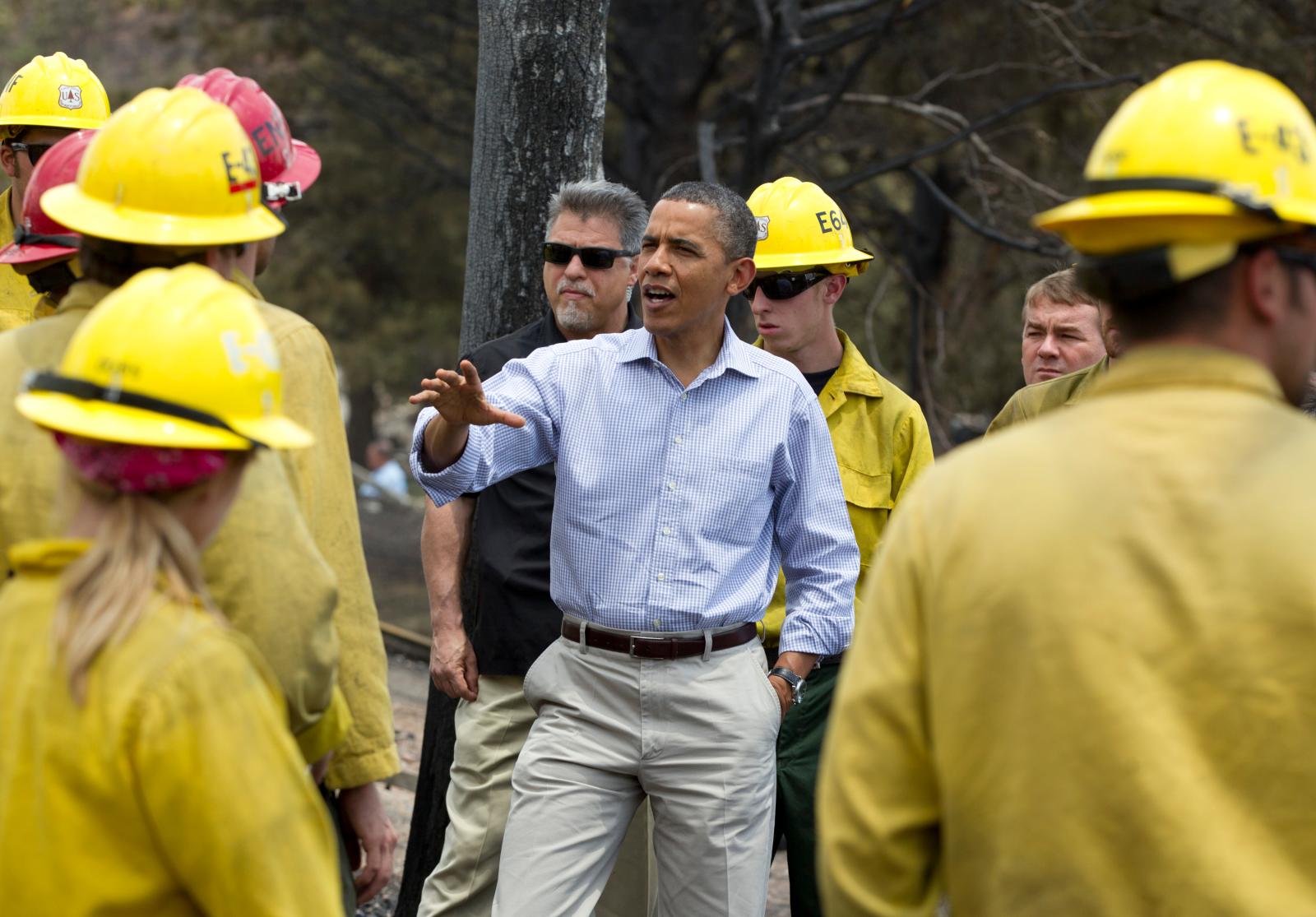
As I write these lines, vast
wildfires are sweeping through my home state of Colorado and other areas of the
American west. Last week, two of my employees had to leave work early to rush
home to evacuate their families from imminent danger. Hundreds of houses have
already been destroyed, and thousands of acres of trees incinerated, and
unknown myriads of wild animals burned alive.
This disaster was predictable,
and promises to get worse. Over the past decade, from British Columbia to New
Mexico, the world’s most rapid deforestation has been underway in the North
American west, with an average of nearly six million acres of forest lost per
year — roughly double the three million acres per year rate in Brazil. The
culprits here, however, have not been humans, but Western Pine Beetles, whose
epidemic spread has turned over 60 million acres of formerly evergreen pine
forests into dead red tinder, dry ammunition awaiting any spark to flare into
catastrophe.
On Equality and Inequality
Equality, Natural Rights and Killing Fields
By Ludwig von Mises
By Ludwig von Mises
Different and Unequal
The doctrine of natural law that inspired the 18th
century declarations of the rights of man did not imply the obviously
fallacious proposition that all men are biologically equal. It proclaimed that
all men are born equal in rights and that this equality cannot be abrogated by
any man-made law, that it is inalienable or, more precisely, imprescriptible.
Only the deadly foes of individual liberty and self-determination, the
champions of totalitarianism, interpreted the principle of equality before the
law as derived from an alleged psychical and physiological equality of all men.
The French declaration of the rights of the man and
the citizen of November 3, 1789, had pronounced that all men are born and
remain equal in rights. But, on the eve of the inauguration of the regime of
terror, the new declaration that preceded the Constitution of June 24, 1793,
proclaimed that all men are equal "par la nature." From then
on this thesis, although manifestly contradicting biological experience,
remained one of the dogmas of "leftism." Thus we read in the Encyclopaedia
of the Social Sciences that "at birth human infants, regardless
of their heredity, are as equal as Fords."[1]
Angela Merkel is Playing You For Fools
Taking Germany out of the picture
By Raoul Ilargi
Oh, come on, leave the girl alone already. First off, all those people
talking about a solution for the eurozone need to finally understand there
ain't no such thing. And whatever slim chance of a solution the most optimistic
- delusional - among them may be so desperate to cling on to, at least they
should recognize that Angela doesn't hold the keys to the city. She herself
knows it: she's just another gal knocking at the gates, even if she's dressed
as the empress.
A thought experiment: how would you solve the euro
crisis if Germany were not part of the equation? If you would have to put the
de facto German contribution to the puzzle at zero, neutral? What would you be
left with then, and what steps would have to be taken to come to a solution? If
the sole remaining big players were, let's see, France, Spain and Italy?
That changes the picture, doesn't it? Take Germany out
and all you're left with is pretty much roadkill. Plus a motley crue of
comparatively small barely breathing rodents like Holland, Finland and Austria.
Two Ways, But Where To?
Electoral fear may be the only medicine
By Anthony de Jasay
Having
for a pulpit a regular column in the New York Times, Paul
Krugman speaks to us as one who is really sure about what is what. He is also
thoroughly exasperated by the pigheaded blindness of those of us who have their
hands on the levers of policy and are responsible for the astronomical waste
and needless pain inflicted on the economies on both sides of the Atlantic and
especially on the Eurozone. His thesis is that we are actually in a state of
genuine depression, involving a loss of potential output that hardly bears
thinking about. The depression is of our own making and is unnecessary, serving
no purpose. It ought to be and could be terminated forthwith.
When Push Comes to Shove ...
Roberts switched views to uphold health care law
By Jan Crawford
(CBS News) Chief Justice John
Roberts initially sided with the Supreme Court's four conservative justices to
strike down the heart of President Obama's health care reform law, the
Affordable Care Act, but later changed his position and formed an alliance with
liberals to uphold the bulk of the law, according to two sources with specific
knowledge of the deliberations.
Roberts then withstood a
month-long, desperate campaign to bring him back to his original position, the
sources said. Ironically, Justice Anthony Kennedy - believed by many
conservatives to be the justice most likely to defect and vote for the law -
led the effort to try to bring Roberts back to the fold.
"He was relentless,"
one source said of Kennedy's efforts. "He was very engaged in this."
But this time, Roberts held
firm. And so the conservatives handed him their own message which, as one
justice put it, essentially translated into, "You're on your own."
Monday, July 2, 2012
Go figure, the poorest place in Europe is run by Communists
Next stop, Greece
By Simon Black
Ah Moldova… the poorest country in
Europe, which just so happens to have had a Communist party majority in
its parliament since 1998.
These
two points are not unrelated.
Despite
having achieved its independence from the Soviet Union over 20 years ago,
the state is still a major part of the Moldovan economy…from setting prices and
wages to media, healthcare, agricultural production, air transport, and
electricity.
Under
such management, it’s no wonder, for example, that Moldova has to import
75% of its electricity. It is the exact opposite of self-sustaining.
The
government does a reasonable job of chasing away foreigners as well.
It's Never Been Better
As a
Share of Household Spending, U.S. Has Most Affordable Food in World
by Mark Perry
We hear reports all the time
that real household incomes are stagnant or falling, the middle class is
disappearing, household wealth has declined, and income inequality is
rising. All of those reports might make one think that the standard of
living for the average American is bad and getting worse. But here's one
basic measure of a country's standard of living that shows Americans are better
off than their consumer counterparts anywhere in the world: The share of
household consumption expenditure on food consumed at home, see table below
(USDA data
here).
Relative to our total household spending, Americans have the cheapest food on the planet - only 6.6% of the average household budget goes to food consumed at home. European countries like Spain, France and Norway spend twice that amount on food as a share of total expenditures, and consumers in countries like Turkey, China and Mexico spend three times as much of their budgets on food as Americans.
Oh, How the Mighty are Falling
"I like nonsense, it wakes up the brain cells"
While the markets look at what
took place at the last Summit and rally; just wait, it won’t last long. The
markets are getting mislead, one more time, by the spin that Europe places on
events; by the focus that the giant European propaganda machine spits out from
various sources again and again and again. You may recall, in the not too
distant past, how the firewall was the thing, how the money needed to be bigger
and how we were all led to believe that this giant, massive wall of Euros would
protect the core nations of Europe. These nations included Spain and Italy
without question and now the first mighty oak has fallen as Spain stepped up to
the plate and swung the begging bat.
Saving everybody's face
The real victor in Brussels
was Merkel
By Wolfgang Münchau
By Wolfgang Münchau
Mario Monti faced down the
German chancellor and won the battle. He will survive a few more weeks or
months in politics. It was clever of him to threaten a veto on something Angela
Merkel badly needed. He had her in the corner. It was an example of classic EU
diplomacy.
But this was only the foreground
spectacle. If you look behind the curtain, you will find that, for Italy at
least, nothing has changed at all. The European Stability Mechanism was already
able to purchase Italian bonds in the open market. The instrument was there,
but not used. The agreed changes are subtle. Italy must still sign a memorandum
of understanding, and subject itself to the troika – the International Monetary
Fund, the European Central Bank and the European Commission.
Learning To Laugh At the State
The state, with all of its coercive power, can’t take that away
by James
Miller
I’ll be the first to admit the
incredible aggravation I feel whenever liberty is trampled upon by the state’s
obedient minions. Everywhere you look, government has its gun cocked back
and ready to fire at any deviation from its violently imposed rules of
order. A four year old can’t even open a lemonade stand without first bowing down and receiving a permit from
bureaucrats obsessed with micromanaging private life. The state’s
stranglehold on freedom is as horrendous as it is disheartening.
The worst part is that the
trend shows no signs of slowing down, let alone reversing. Politicians
are always developing some harebrained scheme to mold society in such a way to
circumvent the individual in favor of total dictation. If it isn’t
politicians, then it’s an army of unelected bureaucrats acting as
mini-dictators. As the late Swedish economist Gustav Cassel once lectured:
Is this 1936?
But while the Justices continued to dance in 1936, the music had died
By David Bernstein
Before the ACA
decision was announced, many liberal pundits warned that the Supreme Court was
on the verge of repeating its mistake in 1936, when the Court revealed that
retained a 5-4 majority hostile to broad regulation of economic activity.
These pundits suggested that if the modern Court invalidated the ACA, it would
be repeating the mistake of its conservative New Deal-era predecessor.
The Court would then face a backlash of the sort that led to FDR’s
Court-packing plan, and ultimately to the famous “switch in time that saved
nine.”
Egypt Holds Its Breath
The junta certainly has no intention of abandoning its vast economic empire
by Omar Ashour
by Omar Ashour
“You are the authority, above any other authority. You are the protectors, whoever seeks protection away from you is a fool...and the army and the police are hearing me,” said Egypt’s president-elect, Mohamed Morsi, to hundreds of thousands in Tahrir Square. A man imprisoned following the “Friday of Rage” (January 28, 2011) took the presidential oath in Tahrir on a “Friday of Power Transfer” (June 29, 2012).
But he almost did not.
Ten days
earlier, on June 19, I was with a group of former Egyptian MPs in Tahrir
Square. One received a phone call informing him that a senior Muslim
Brotherhood leader was coming to announce that the group was being blackmailed:
either accept the constitutional addendum decreed by the Supreme Council of the
Armed Forces (SCAF), which practically eviscerated the presidency, or the
presidential election’s outcome would not be decided in the Brothers’ favor. An
hour later, the senior figure had not shown up. “The talks were about to collapse,
but they resumed,” said the former MP. “Hold your breath.”
The Origin Of Money
Who should create the monetary medium?
by John Aziz
by John Aziz
Markets are true
democracies. The allocation of resources, capital and labour is achieved
through the mechanism of spending, and so based on spending preferences. As
money flows through the economy the popular grows and the unpopular
shrinks. Producers receive a signal to produce more or less based on
spending preferences. Markets distribute power according to demand and
productivity; the more you earn, the more power you accumulate to allocate
resources, capital and labour. As the power to allocate resources (i.e. money)
is widely desired, markets encourage the development of skills, talents and
ideas.
Planned economies
have a track record of failure, in my view because they do not have this
democratic dimension. The state may claim to be “scientific”, but as Hayek
conclusively illustrated, the lack of any real feedback mechanism has always
led planned economies into hideous misallocations of resources, the most
egregious example being the collectivisation of agriculture in both Maoist
China and Soviet Russia that led to mass starvation and millions of deaths. The
market’s resource allocation system is a complex, multi-dimensional process
that blends together the skills, knowledge, and ideas of society, and for which
there is no substitute. Socialism might claim to represent the wider interests
of society, but in adopting a system based on economic planning, the wider
interests and desires of society and the democratic market process are ignored.
This complex
process begins with the designation of money, which is why the choice of the
monetary medium is critical.
Like all
democracies, markets can be corrupted.
Whoever creates
the money holds a position of great power — the choice of how to allocate
resources is in their hands. They choose who gets the money, and for what, and
when. And they do this again and again and again.
Chief Justice Roberts and His Apologists
Some conservatives
see a silver lining in the ObamaCare ruling. But it's exactly the
big-government disaster it appears to be
White House judge-pickers
sometimes ask prospective nominees about their favorite Supreme Court justice.
The answers can reveal a potential judge's ideological leanings without
resorting to litmus tests. Republican presidential candidates similarly promise
to appoint more judges like so-and-so to reassure the conservative base.
Since his appointment to the
high court in 2005, the most popular answer was Chief Justice John Roberts. But
that won't remain true after his ruling on Thursday in NFIB v. Sebelius,
which upheld President Barack Obama's signature health-care law.
Justice Roberts served in the
Reagan Justice Department and as a White House lawyer before his appointment to
the D.C. Circuit Court of Appeals and then to the Supreme Court by President
George W. Bush. Yet he joined with the court's liberal wing to bless the
greatest expansion of federal power in decades.
Sunday, July 1, 2012
Germany Cries: "Europe Is Coming For Our Money"
Greece Promptly Obliges
by Tyler durden
"Greece is an exception in the Euro Zone" - Angela Merkel, December 9, 2011
"Exception from ESM Seniority only applies to Spanish aid" - Angela Merkel, June 29, 2012
It took about a year, but finally
Germany, with a little assistance from Merkel on Friday morning, has figured it
out. And is now blasting it on the front pages of its various newpapers:
Europe is coming for our money!
When economic historians in a few years determine the turning point at which the euro zone turned into a debt community, they may refer to the last Thursday night. In those dramatic hours when Angela Merkel after massive pressure from Italian Prime Minister Mario Monti and Spanish Prime Minister Mariano Rajoy buckled - and agreed to an agreement whose scope is now very difficult to estimate.
Government Medical "Insurance"
Everyone has the right to free medical care, but there is, in effect, no medicine and no care
by Murray N. Rothbard
One of Ludwig von Mises's keenest insights was on the
cumulative tendency of government intervention. The government, in its wisdom,
perceives a problem (and Lord knows, there are always problems!). The
government then intervenes to "solve" that problem. But lo and
behold! instead of solving the initial problem, the intervention creates two or
three further problems, which the government feels it must intervene to heal,
and so on toward socialism.
No industry provides a more dramatic illustration of
this malignant process than medical care. We stand at the seemingly inexorable
brink of fully socialized medicine, or what is euphemistically called
"national health insurance." Physician and hospital prices are high
and are always rising rapidly, far beyond general inflation. As a result, the
medically uninsured can scarcely pay at all, so that those who are not
certifiable claimants for charity or Medicaid are bereft. Hence, the call for
national health insurance.
But why are rates high and increasing rapidly? The
answer is the very existence of healthcare insurance, which was established or
subsidized or promoted by the government to help ease the previous burden of
medical care. Medicare, Blue Cross, etc., are also very peculiar forms of
"insurance."
Laissez-Faire Learning
The Emperor is still naked
by David Greenwald
by David Greenwald
As a teacher in a public high school, I am daily
confronted with the lamentable realities of state-monopoly education. Student
apathy, methodological stagnation, bureaucratic inefficiency,
textbook-publishing cartels, obsessive preoccupation with grades, coercive
relationships, and rigid, sanitized curricula are just a few of the more
obvious problems, attended by the cold-shower disillusionment and gradual
burnout among teachers to which they almost invariably lead.
While outcomes such as these are certainly tragic, the
process that produces them is not exactly the stuff of Greek theater. There is
no climactic battle, no cathartic denouement, no salvific moral lesson to be
taken home when the curtain falls, and seldom are there any readily
identifiable heroes or villains. It is not a single, epic calamity but a
thousand trivial defeats a day, each too mundane and too quickly obscured by
its successor to be considered noteworthy. Like a bad movie, public education
somehow manages to be both tragic and boring. It is only its cumulative result
that would have impressed Sophocles.
Subscribe to:
Comments (Atom)