Tuesday, May 7, 2013

We Are All to Blame

.. or Is It the Others?


by Theodore Dalrymple 
When, many years ago, I started regularly to review books for profit and pleasure (my profit and pleasure, that is), I thought it would be fun to write destructive reviews of bad books. I was beguiled into this idea by having read Macaulay’s eviscerating essay-review, which I found delightful, of a three-volume biography of Lord Burleigh:
Compared with the labour of reading through these volumes, all other labour, the labour of thieves on the treadmill, of children in factories, of negroes in sugar plantations, is an agreeable recreation. There was, it is said, a criminal in Italy, who was suffered to make his choice between Guicciardini and the galleys. He chose the history. But the war of Pisa was too much for him. He changed his mind, and went to the oar.
(Guicciardini was a contemporary of Machiavelli and wrote a history of Italy.)

Why the Left Frequently IS Right

....And Vice Versa

by Fergus Downie 
In Arthur Koestler’s wartime novel Arrival and Departure, there is a striking scene where the author introduces a prototypically modern Nazi diplomat who expounds on the intrinsically modern and revolutionary character of the Third Reich, before descanting on a vision of Europe, in which history and tradition are rendered a junkyard. It is worth quoting at some length as it highlights a feature of the fascist imagination which is rarely explored with any intellectual rigour and consistency.
The laws of orthodox economy, customs, currency, frontiers, parliaments, churches, vested sacraments and institutions, marriage, ten commandments—all mumbo-jumbo. We start from scratch. I'll tell you how. . . Close your eyes. Imagine Europe up to the Urals as an empty space on the. map. There are only fields of energy: hydro-power, magnetic ores, coal-seams under the earth, oil-wells, forests, vineyards, fertile and barren lands. Connect these sources of energy with blue, red, yellow lines and you get the distributive network.

The Cyprus Bank 'Bail-In' Is Another Crony Bankster Scam

The cronies get 100% or more; the non-cronies get a kick in the guts 
By Nathan Lewis
A new strategy has been unveiled around the world, with the first test run in Cyprus. Despite early denials, the “bail-in” strategy for insolvent banks has already become official policy throughout Europe and internationally as well.
At first glance, the “bail-in” resembles the normal capitalist process of liabilities restructuring that should occur when a bank becomes insolvent. Equity investors and most-junior creditors lose everything; less-junior creditors get a debt/equity conversion, and senior creditors get 100%. The bank can remain in operation, and does not have to liquidate any assets. No public money is required.
I have been an advocate of restructuring insolvent banks according to these basic capitalistic principles, which requires no public funds.
The difference with the “bail-in” is that the order of creditor seniority is changed. In the end, it amounts to the cronies (other banks and government) and non-cronies. The cronies get 100% or more; the non-cronies, including non-interest-bearing depositors who should be super-senior, get a kick in the guts instead.
All insured deposits (individuals and legal entities) up to €100.000 have, as of 26 March 2013, been transferred from Laiki Bank to the Bank of Cyprus. In addition, the entire amount of deposits belonging to financial institutions, the government, municipalities, municipal councils and other public entities, insurance companies, charities, schools, educational institutions, and deposits belonging to JCC Payment Systems Ltd have been transferred to the Bank of Cyprus.
All other deposits exceeding €100.000 remain in the ‘bad’ Laiki Bank.

Monday, May 6, 2013

A Tale of Two Oil States

While the shale boom lifts Texas, California sits on vast resources


WSJ Editorial
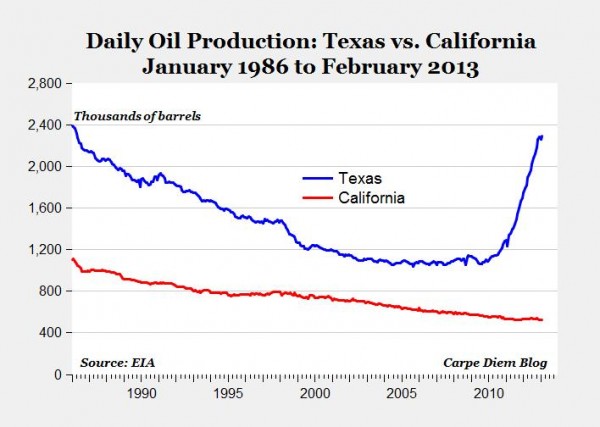
Texas and California have been competing for years as U.S. growth models, and one of the less discussed comparisons is on energy. The Golden State has long been one of America's big three oil producing states, along with Texas and Alaska, but last year North Dakota surpassed it. This isn't a matter of geological luck but of good and bad policy choices.
Barely unnoticed outside energy circles, Texas has doubled its oil output since 2005. Even with the surge in output in North Dakota's Bakken region, Texas produces as much oil as the four next largest producing states combined. The Lone Star State now pumps nearly two million barrels a day, and Texas Railroad Commissioner Barry Smitherman (who is also oil commissioner) says "total production could double by 2016 and triple by the early 2020s." The entire U.S. now produces about seven million barrels a day.

Pulling Down Germany to ‘Rescue’ the EU?

Bizarre Economic Theories On the Rise
By Pater Tenebrarum
It is really astonishing what passes for 'economic logic' these days. A favorite mainstream meme regarding the euro area is the perverse plan to make things better for everyone by making them worse for Germany. You would think that our bien pensants should be happy that Germany's economy is fairly strong, considering that it is supposed to bail out all and sundry. Not so. Instead it is held that Germany's success, especially in terms of foreign trade, comes at the expense of  everybody else and therefore represents everybody else's loss.
The tenacity with which such mercantilist fallacies are clinging to the minds of people is simply incredible. First of all, 'nations' don't trade with each other – people do. National borders are entirely incidental to this fact and possess no particular economic significance. Secondly, there are no 'losers' in voluntary trade; every trade is mutually beneficial. If it were not, the parties concerned would not engage in trade with each other. What's so hard to grasp about this? 
Keeping the above in mind, here is what the EU's social affairs commissar Laszlo Andor thinks, according to Der Spiegel
“European Union Social Affairs Commissioner László Andor is calling on Germany and other euro-zone donor countries to change course in combating the European debt crisis. Austerity in Southern Europe alone will not fix the problem, Andor told the German daily Süddeutsche Zeitung in an interview published Monday — the north also needs to spend more. He suggests shifting the focus from reforms, austerity and consolidation of national budgets toward economic stimulus."Saving alone does not create growth. That requires additional investment and demand," said Andor […]

Erdogan drags heavy bag to Washington

As long as Assad stays in office, Erdogan loses power in Turkish politics and risks losing at elections in 2014
By Egemen B Bezci 
Turkish Prime Minister Recep Tayyip Erdogan will be greeted by Barack Obama at the White House today after waiting more than six months for an appointment since the US president was elected for a second term in November. Weighty issues accompany Erdogan into the meeting between the two heads of state. 
Erdogan's visit to Washington follows frequent visits to Turkey by US Secretary of State John Kerry since took the post in February. Since then, rapid developments in the Middle East have brought new opportunities and threats. The most recent one was last weekend's car bomb attack in the Turkish town of Reyhanli near the Syrian border that claimed the lives of more than 50 Turkish citizens. The incident created more stress on a Turkish government that is already searching for a solution to the already complicated Syria problem. 
In the light of all these developments, three important issues mark Erdogan's agenda during his time in the White House; namely, the Syrian issue, relations with Israel and, significantly, energy politics. It is remarkable to note that for the first time in contemporary Turkish politics, a prime minister will not have to push the Kurdish issue. Erdogan's recent democratic initiative has resulted in a ceasefire with Kurdish militants. 
The ceasefire secured on March 21 between the Kurdistan Workers' Party (PKK) and Ankara is one of the key factors for understanding the puzzle of energy politics in the Middle East. The three-decade-long struggle between the PKK, a Kurdish armed secessionist organization that long-operated across Turkey, Iraq, Iran and Syria as it pursued the establishment of an independent Kurdish state, had claimed more than 30,000 lives and has been a source of instability along the trajectory of Turkey's border with Iraq, Iran and Syria. 

Keynes stole your ship

Dysfunction Trilogy Part A

By Chan Akya
Despite mounting evidence of the dysfunction being caused by Keynesian policies, rhetoric in Europe and the United States is overwhelmingly turned against austerity. Over three articles, the author will examine specific examples of the dysfunction that has been caused by such government intervention, and the very real economic pain being caused as a result with the objective of dispelling the dangerous notion that higher government spending is a victimless crime.
Here is a quick quiz: name a global industry that is as old as antiquity, employs millions of people, withstood and indeed thrived with technological change but perhaps most importantly of all with diverse supply and demand dynamics is an industry that has never been cornered by any particular group for very long in history. 
If you thought the reference above was about shipping, well done. In contrast if you thought it was about prostitution, well then, time for a cold shower. 
The typical cycle of shipping is as old as history and has always been about two contrasting and virtually uncorrelated forces: firstly the interaction of operations with risk, and secondly the boom-bust cycle. Western readers will remember learning about the exploits of sea-faring Greeks and other Mediterranean peoples as merchants far and wide seeking to profit from trade with other countries. This continued into the times of Shakespeare (examples include the Merchant of Venice and settled into modern times as shipping became the moving force of global economies post World War II. The advent of standardized containers during the Korean War and thereafter proved a boon for global trade, and with it, improved the economic fortunes of all countries involved.

Sunday, May 5, 2013

What Austerity?

Debunking the Liberal Narrative
By J.T. Young
The emperor’s new clothes were invisible; in Washington’s fiscal fairy tale, austerity is too. Although an increasing number of people are expressing concern that federal spending cuts are endangering the economy, it begs a fundamental question: What austerity?
It is understandable why last week’s 2.5 percent real GDP growth figure troubled many. First, it was below the consensus 3 percent expectation. More importantly, the economy has been dismal for so long that America’s conditioned reflex is despondency.
Even though America’s last negative growth quarter was 2009’s Q2, the economy’s annual real growth rate has underperformed thusly: 2009, minus-3.1 percent; 2010, 2.4 percent; 2011, 1.8 percent; and 2012, 2.2 percent. If the Blue Chip consensus forecast is correct, this year growth will also be just 2.2 percent -- something last week’s figure made much more likely.
After four-years-going-on-five of such economic anemia, liberals sorely need a new culprit -- especially with their favorite whipping boy, George W. Bush, now far removed from office. Enter Europe, stage left. Or rather, Europe’s “austerity,” to be more precise.

Long-Term Unemployment Is Turning Jobless Into Pariahs

The U.S. is in dire danger of having a permanent class of long-term unemployed
By Bloomberg
Long-term unemployment is one of the most vexing problems the U.S. faces, and today’s jobs report shows all-too-meager progress in fixing it.
The U.S. created 165,000 new jobs in April, pushing down the unemployment rate to 7.5 percent from March’s 7.6 percent. But as of the end of April, 4.4 million Americans, or 37 percent of the unemployed, had been without a job for 27 weeks or longer, barely better than March’s 39 percent. The U.S. can’t afford to write off more than 4 million people who would like to work but haven’t for more than six months.
Long-term joblessness peaked in April 2010 at 6.7 million, so the picture might seem to be improving. Hidden within that number is this troubling fact: The average unemployed person has been out of work for 36.5 weeks. That’s not much better than the December 2011 duration of 40.7 weeks, which was the longest since World War II. Long-term unemployment at the start of the recession in December 2007 was 1.3 million people, and the average duration was 16.6 weeks.
Terrible things happen to people when they are out of work for long periods, numerous studies show. Beyond a sharp drop in income, long-term unemployment is associated with higher rates of suicide, cancer (especially among men) and divorce. The children of the long-term unemployed also show an increased probability of having to repeat a grade in school.

The Coming Demographic Crisis

What should we expect when no one is expecting?
by Bruce Thornton
For two centuries, overpopulation has haunted the imagination of the modern world. According to Thomas Malthus, writing in 1798, human population growth would always surpass agricultural production, meaning “gigantic inevitable famine” would “with one mighty blow level the population with the food of the world.”
Later, eugenicists like Margaret Sanger in the 1920s fretted over the wrong people reproducing too much, creating what she called “human weeds,” a “dead weight of human waste” to inherit the earth. In 1968, Paul Ehrlich predicted that in the 1970s, “hundreds of millions of people are going to starve to death” because of the “population bomb.” These days, environmentalists worry that too many people will overload the natural world’s resources and destroy the planet with excessive consumption and pollution, leading to catastrophic global warming.
A strain of anti-humanism has always run through population paranoia, a notion that human beings are a problem rather than a resource. But as Jonathan Last documents in his new book What to Expect When No One’s Expecting, it is not overpopulation that threatens the well-being of the human race, it is under-population. As Last writes, “Throughout recorded human history, declining populations have always been followed by Very Bad Things.” Particularly for our modern, high-tech, capitalist world of consumers who buy, entrepreneurs who create wealth and jobs, and workers whose taxes fund social welfare entitlements, people are an even more critical resource.

The Immigration Transformation

A rational immigration reform would attempt to reorient, not accelerate, current policy
By Mark Steyn
Most countries in the world have irrelevant numbers of “immigrants.” In the Americas, for example, only Canada, America, and the British West Indies have significant non-native populations. In Mexico, immigrants account for 0.6 percent of the population, and that generally negligible level prevails all the way down through Latin America until you hit a blip of 1.4 percent with Chile and 3.8 percent in Argentina. There’s an isolated exception in Belize, which, like the English Caribbean, has historical patterns of internal migration within the British Commonwealth, such as one sees, for example, in the number of New Zealand–born residents of Australia. But profound sweeping demographic transformation through immigration is a phenomenon only of the Western world in the modern era, and even there America leads the way. Over 20 percent of all the immigrants on the planet are in the United States. The country’s foreign-born population has doubled in the last two decades to 40 million — officially. Which is the equivalent of Washington taking a decision to admit every single living Canadian, and throwing in the population of New Zealand as a bonus. Thank goodness they didn’t do that, eh? (Whoops.) Otherwise, America would have been subject to some hideous, freakish cultural transformation in which there would be hockey franchises in Florida, and Canadian banks on every street corner in New York trumpeting their obnoxious jingoistic slogans (“TD: America’s neighborhood bank”), and creepy little pop stars with weird foreign names like Justin and Carly Rae doing the jobs America’s teen heartthrobs won’t do. What a vile alien nightmare that would be to wake up in.

A Brief History of American Prosperity

An entrepreneurial culture and the rule of law have nourished the nation’s economic dynamism


By Guy Sorman
Worry over America’s recent economic stagnation, however justified, shouldn’t obscure the fact that the American economy remains Number One in the world. The United States holds 4.5 percent of the world’s population but produces a staggering 22 percent of the world’s output—a fraction that has remained fairly stable for two decades, despite growing competition from emerging countries. Not only is the American economy the biggest in absolute terms, with a GDP twice the size of China’s; it’s also near the top in per-capita income, currently a bit over $48,000 per year. Only a few small countries blessed with abundant natural resources or a concentration of financial services, such as Norway and Luxembourg, can claim higher averages.
America’s predominance isn’t new; indeed, it has existed since the early nineteenth century. But where did it come from? And is it in danger of disappearing?
By the 1830s, the late British economist Angus Maddison showed, American per-capita income was already the highest in the world. One might suppose that the nation could thank its geographical size and abundance of natural resources for its remarkable wealth. Yet other countries in the nineteenth century—Brazil is a good example—had profuse resources and vast territories but failed to turn them to comparable economic advantage.
A major reason that they failed to compete was their lack of strong intellectual property rights. The U.S. Constitution, by contrast, was the first in history to protect intellectual property rights: it empowered Congress “to promote the Progress of Science and useful Arts, by securing for limited Times to Authors and Inventors the exclusive Right to their respective Writings and Discoveries.” As Thomas Jefferson, who became the first commissioner of the patent office, observed, the absence of accumulated wealth in the new nation meant that its most important economic resource was innovation—and America’s laws encouraged that innovation from the outset. Over two centuries later, the United States has more patents in force—1.8 million—than any other nation (Japan, with 1.2 million, holds second place). America is also the leader in “triadic patents” (that is, those filed in the United States, Europe, and Asia) registered every year—with 13,715 in 2009, the most recent year for which statistics are available, ahead of Japan’s 13,322 and Germany’s 5,764.

Saturday, May 4, 2013

We Are Managing Uncertainty

Ubiquity, Complexity Theory and Sandpiles
By John Mauldin
We are going to start our explorations with excerpts from a very important book by Mark Buchanan, called Ubiquity: Why Catastrophes Happen. I HIGHLY recommend it to those of you who, like me, are trying to understand the complexity of the markets. Not directly about investing, although he touches on it, it is about chaos theory, complexity theory and critical states. It is written in a manner any layman can understand. There are no equations, just easy to grasp, well-written stories and analogies.
 As kids, we all had the fun of going to the beach and playing in the sand. Remember taking your plastic buckets and making sand piles? Slowly pouring the sand into an ever bigger pile, until one side of the pile started an avalanche?
Imagine, Buchanan says, dropping one grain of sand after another onto a table. A pile soon develops. Eventually, just one grain starts an avalanche. Most of the time it is a small one, but sometimes it builds on itself and it seems like one whole side of the pile slides down to the bottom.
Well, in 1987 three physicists, named Per Bak, Chao Tang, and Kurt Weisenfeld began to play the sandpile game in their lab at Brookhaven National Laboratory in New York. Now, actually piling up one grain of sand at a time is a slow process, so they wrote a computer program to do it. Not as much fun, but a whole lot faster. Not that they really cared about sandpiles. They were more interested in what are called nonequilibrium systems.
They learned some interesting things. What is the typical size of an avalanche? After a huge number of tests with millions of grains of sand, they found that there is no typical number. "Some involved a single grain; others, ten, a hundred or a thousand. Still others were pile-wide cataclysms involving millions that brought nearly the whole mountain down. At any time, literally anything, it seemed, might be just about to occur."
The piles were indeed completely chaotic in their unpredictability. Now, let's read this next paragraph from Buchanan slowly. It is important, as it creates a mental image that may help us understand the organization of the financial markets and the world economy. 

The Economic Ignorance of Central Planners

If we want better jobs numbers, we need to deregulate labor markets
by Richard A. Epstein
One story has dominated the economic news this past weekend. The story is that job creation has slowed to a “trickle,” in the words of a Wall Street Journal headline. Only 88,000 new jobs were created in the month of March. That feeble rate was accompanied by the “good” news that the jobless rate, which only counts those actively seeking work as unemployed, had dropped from 7.7 to 7.6 percent.
The real news was that the decline in the unemployment rate was explained by the separation of nearly half a million people from the workforce, so that labor-force participation shrunk from about 67.3 percent in early 2000 to about 63.3 percent today. A crude first approximation of the real unemployment rate would add back at least 4 lost percentage points. A more accurate estimation of the actual unemployment rate would account for those individuals who were out of the market by 2000 in part because of the impediments to market performance that were already in place. 
With these weak numbers, the political discussion has continued to focus on job creation and economic growth: How should these goals be accomplished? On “All Things Considered,” I heard E.J. Dionne advise that the Federal Reserve should keep its foot on the accelerator, by opening the cash spigot and keeping interest rates at their historic lows. At the same time, the rest of the government should put worries about the deficit aside—or so the argument goes—by increasing public expenditures funded in part through higher taxes on the top one percent. David Brooks rightly disparaged that prescription, but still was unable to identify that “big structural change” he hoped would turn the economy around.
Obama’s Misshapen Tax Policy
President Obama had, of course, no doubts on what should be done. In his view, we should double down on the same policies that he has championed since coming into office. His new proposed budget modestly chips away at the cost-of-living increases in Social Security spending, which has drawn fierce resistance from his party’s incorrigible left wing.
But his preferred long-term changes all cut in the opposite direction. The President has renewed his call for capping the charitable deduction at 28 percent—a dreadful idea—even as he tries to steepen the level of progressivity of the income tax. In addition, the President unveiled a proposal to slash the amount of money that individuals can keep in their tax-deferred retirement accounts to $3 million per person. Putting aside the transitional problems that dog this proposal, the simple point is that additional taxation is likely to further retard the creation of jobs and wealth, by shrinking the size of the largest pool of private investment funds in the United States.

The Fed, Lost In The Wilderness

The financial system has “gotten away from” the Fed’s ability to comprehend

by Paul Singer
The Fed is primarily responsible for that state of affairs, and it is out of its depth. Former Chairman Greenspan created – and reveled in – a cult of personality centered on himself, and in the process created a tremendous and growing moral hazard. By successive bailouts and purporting to understand (to a higher and higher level of expressed confidence) a quickly changing financial system of growing complexity and leverage, he cultivated an ever-increasing (but unjustified) faith in the Fed’s apparent ability to fine-tune the American (and, by extension, the world’s) economy. Ironically, this development was occurring at the very time that financial innovations and leverage were making the system more brittle and less safe. He extolled the virtues of derivatives and minimized the danger of leverage and risky securities and dot-com stocks, all while he should have been putting on the brakes. 
It was not just the disappearance of vast swaths of the American financial system into unregulated subsidiaries of financial institutions, nor was it just government policies that encouraged the creation and syndication of “no-documentation” mortgages to people who could not afford them. It was also the low interest rates from 2002 to 2005, the failure to see the expanding real estate bubble caused by an unprecedented increase in leverage and risk, and the general failure to understand the financial conditions of the world’s major institutions. 
Under Chairman Bernanke, the combination of ZIRP and QE completed the passage of the Fed from sober protector of a fiat currency to ineffective collection of frantically-flailing, over-educated, posturing bureaucrats engaged in ever more-astounding experiments in monetary extremism.
If you look at the history of Fed policy from Greenspan to Bernanke, you see two broad and destructive paths quite clearly. One path is the cult of central banking, in which the central bank gradually acquired the mantle of all-knowing guru and maestro, capable of  fine-tuning the global economy and financial system, despite their infinite complexity. On this path traveled arrogance, carelessness and a rigid and narrow orthodoxy substituting for an open-minded quest to understand exactly what the modern financial system actually is and how it really works. The second path is one of lower and lower discipline, less and less conservative stewardship of the precious confidence that is all that stands between fiat currency and monetary ruin. Monetary debasement in its chronic form erodes people’s savings. 

Will The 21st Century Be A Horror Show Of Epic Proportions?

Short Answer - NO
By Tim Reuter
In 2006, Mark Steyn reached two conclusions from his study of anemic Western demographics in his book America Alone. The post World War II global order led by the United States is literally dying, and the future belongs to Islam.
David Goldman, Spengler at Asia Times Online, dismisses those contentions as bogus. “The fastest demographic decline ever registered in recorded history is taking place today in Muslim countries.” World fertility fell from 4.5 to 2.5 children per woman over the past half-century, but “two or three times faster” in Islamic nations. Moreover, the severity of this drop is exacerbated by the “lapsed time” in which it is occurring. Europe spent two centuries descending to its present demographic nadir. Islamic societies are “attempting it [collapsed fertility] in twenty.”
But, this rush towards demographic oblivion is still cause for alarm. It “makes radical Islam more dangerous” because of “Spengler’s Universal Law #1 – A man or a nation at the brink of death does not have a rational self-interest.” As Islamic societies choose de-population, their rational calculus changes. The radicals’ boast that “you love life and we love death” is revealing in this regard. Radical Islamists have chosen to die fighting, rather than watch their societies self-terminate. As Goldman quips, “the flip side of suicide by infertility is jihad.” And, he marshals statistics, history, and philosophy to offer chilling predictions and disturbing recommendations.
Goldman draws on mounds of data to diagnose the Islamic world’s ills, and he dismisses Steyn’s thesis with the qualification of poverty. Old people are an existential threat to Islamic nations because they possess a fraction of Europe’s $30,000 GDP per capita circa 2009. The Middle East’s elderly “rely on their children to care for them.” But today’s bulge of young people will find that neither wealth nor descendants will exist to support them in their old age. The first signs of looming ruin are already apparent in states suffering drastic demographic drop-offs such as Iran (six children per woman), Turkey (five) and Egypt (four)

If you must rescue everything, then ultimately you will be able to rescue nothing.

If The Economy Is So Fragile That Government Can't Allow Failure Then We Are Indeed Close To Collapse
By Seth Klarman
Is it possible that the average citizen understands our country's fiscal situation better than many of our politicians or prominent economists?
Most people seem to viscerally recognize that the absence of an immediate crisis does not mean we will not eventually face one. They are wary of believing promises by those who failed to predict previous crises in housing and in highly leveraged financial institutions.
They regard with skepticism those who don't accept that we have a debt problem, or insist that inflation will remain under control. (Indeed, they know inflation is not well under control, for they know how far the purchasing power of a dollar has dropped when they go to the supermarket or service station.)
They are pretty sure they are not getting reasonable value from the taxes they pay.
When an economist tells them that growing the nation's debt over the past 12 years from $6 trillion to $16 trillion is not a problem, and that doubling it again will still not be a problem, this simply does not compute. They know the trajectory we are on.
When politicians claim that this tax increase or that spending cut will generate trillions over the next decade, they are properly skeptical over whether anyone can truly know what will happen next year, let alone a decade or more from now.
They are wary of grand bargains that kick in years down the road, knowing that the failure to make hard decisions is how we got into today's mess. They remember that one of the basic principles of economics is scarcity, which is a powerful force in their own lives.
They know that a society's wealth is not unlimited, and that if the economy is so fragile that the government cannot allow failure, then we are indeed close to collapse. For if you must rescue everything, then ultimately you will be able to rescue nothing.

The Economics Of Decline

There is always a price
by Mark J. Grant
I have long stated that one of the ways our current party might end is by an “Event.” The most likely suspect here has long been in Europe. An uprising, a change in the democratic political climate, a refusal to accept more funding with onerous terms, a refusal to fund as cash runs out. There are a host of possibilities here. 
It is more than likely that Portugal will be back at the trough soon and then there is Slovenia and more money for Greece and there is quite a list of upcoming traumas. It is also likely that Italy and Spain may be forced to the window and then the calls on capital will be enormous.
Leaving some “Event” aside however we are surely facing an economic decline both in Europe and in America. The reason is simple enough; it is the consequence of what the central banks are doing. The lowering of interest rates to miniscule levels has a cost and while the cost is not immediately paid or apparent; it is there and now, after some time has passed, right in front of our noses.
Consumers and investors and the people with money are what keep any economy growing. As each month passes and as months turn into years since the central banks began their actions; disposable income has been declining. If you got 5.00% on a ten year Treasury and now you are getting less than 2.00% then possible purchasing power has declined by 60%. This is true for all classes of fixed income assets. While bond compression has helped with portfolios; maturities and calls are causing havoc with available funds that can be spent. Those with money have significantly less to spend.

Civil Liberties After Boston

High stakes for law enforcement
by Richard A. Epstein
In the aftermath of the terrorist bombing—no lesser word will do—at the Boston Marathon, a major debate has broken out over the proper law enforcement procedures in two key areas: general surveillance and targeted searches. Many insist that a general right to privacy should limit the first, and that concern with racial and ethnic profiling should limit the second. Both of these overinflated concerns should be stoutly resisted.
The task of unearthing terrorist activities is like looking for a needle in the haystack. Even the best system of oversight and surveillance will turn up an extraordinarily high percentage of false positives, for the simple reason that the odds of any given lead providing useful information, although hard to estimate, may be very small. It takes, therefore, a very large payoff indeed to justify government action in those cases, which is why police surveillance and monitoring should receive high priority only in cases where the risk justifies the large public expenditures and the serious intrusions on privacy of those targeted individuals. At this point, the questions arise of what kind of surveillance should be used, and when and how law enforcement officials can target particular individuals. 
The Way Forward on Surveillance
The Tsarnaev brothers’ attack at the Boston Marathon has brought forth an insistent public call for an increase in surveillance to detect suspicious activities before it is too late. To be sure, there are always technical difficulties in using surveillance devices. But any objection on that ground should be treated solely as means-ends questions, which can in large measure be answered by improved software in such key areas as facial recognition detection. The moral, social, and constitutional objections are sadly misplaced.

Liberal Learning in the Marketplace

Thinking About Liberal Education With Adam Smith
 
by Joseph M. Knippenberg
I make no claims to a high level of expertise in the philosophy of Adam Smith.  This is the first time I have spoken about Smith outside of a classroom setting.  I assign selections from The Theory of Moral Sentiments and The Wealth of Nations in a sophomore-level core course, so the students and I discuss his work without any of us proposing to specialize in it.  The irony of approaching Smith in this way is certainly not lost on me.
Nonetheless, I think that it makes sense to think about liberal education with Smith because we live, work, educate, and are educated in a “market society.”  It is impossible not to think about the “job market,” the “higher education marketplace,” and so on.  The notion of liberal education certainly antedates the ascendancy of the capitalist market, and the question of how the two fit together, if at all, ought to be taken seriously by all those who profess to be devoted to liberal learning in the contemporary world.
Let me take as my point of departure Smith’s discussion of the division of labor in Book I of Wealth.  There he argues that this very division of labor is the principal cause of the wealth of nations, perhaps the most important consideration in an account of the human good.  The great collective wealth, from which we all benefit to one degree or another, follows from the division of any complex work into a multitude of smaller tasks.  In the course of explaining why this arrangement is so productive, Smith makes a number of arguments, the last of which has to do with the role of inventions and machinery in enabling us to accomplish these smaller and simpler tasks more efficiently and hence more productively.  Many labor-saving machines are themselves, he avers, products of the division of labor.
Men are much more likely to discover easier and readier methods of attaining any object, when the whole attention of their minds is directed towards that simple object, than when it is dissipated among a great variety of things.  (165)
There are a few of things about this statement that are noteworthy.  In the first place, Smith is stating what is arguably a general truth about the human mind: at least when it is seeking means toward an end, it gains power through a narrowed focus.  In any human endeavor, it would seem, specialization seems to produce greater results than synopsis and synthesis, than taking a sort of grand overview. The latter seems, as Smith says, to be kind of “dissipation,” hardly a compliment in any circumstance.  Second, this observation has no necessary bearing on theory for its own sake.  Means-end rationality, or (if you will) instrumental reason, profits from this narrow focus.  It is hard to believe that (grand) theorizing as an end in itself would similarly benefit.  It would not then be “grand,” would it?