Thursday, January 26, 2012

Jack and Jill going down

The extras will all be cast as cannon fodder
By Ilargi
For today’s global financial problems, there are no solutions that are favorable to either incumbent politicians or wannabe leaders (unless they’re extremists; perhaps), let alone to the people they claim to represent. All our herd of leaders can do is to postpone the inevitable outcome of inevitable processes as long as possible. 

That's why we see Obama presenting yet another housing plan that won't work, and Europe setting up the umpteenth Save Greece concoction that is doomed to fail before it's signed - if that happens at all -. Obama knows it, and so do Europe's leaders. 


The disaster they're seeking to avert, it seems, is not so much economic depression as it is their being voted out of office. And this pattern is not going to change, not as long as they can keep up appearances by seizing ever more of our children's future wealth, not as long as we let them. 

Greece is negotiating a deal with investors to achieve a 70% haircut on existing bonds, up from 21% hardly more than half a year ago, and it still won't be enough. The 49% increase since last summer should be a huge red flag for everyone. 

Why that increase? Well, first of all of course because 21% was always ridiculously low. But something else is happening too: the biggest developing problem for Europe is that a Greek default can increasingly be enormously profitable for certain parties in the market. And why should they then work to "save" Greece? 
It has been clear for a long time now that Greek bonds have no value left at all. During that time, the smarter kids in the class have been able to position themselves according to that fact. Therefore the noose around the EU and ECB necks gets pulled in tighter as we go along. And as the ridiculous notion of the 70% haircut being labeled as "voluntary" keeps being touted.

The IMF is pressuring the ECB to also take a haircut. Other central banks and sovereigns are next in line. Hello, Fed! Hey, China! The ECB wants to sell its Greek paper to one of the European emergency funds, which can then take the haircut. Musical chairs are making a come-back as a highly popular game these days. 

The smarter kids are laughing all the way to all the banks as they are paid all the money they want by all the bankrupt nations seeking to hide their insolvency from their own citizens, squandering those very citizens' scarce remaining wealth in the process.

We can only keep our societies alive and running by telling a seemingly never ending series of lies. And if everyone had the same interests, this delusion could last quite a while; we’ve been doing it for 4-5 years already, after all (and arguably for much longer). But not everybody has the same interests, not anymore. 


University 2.0

A Revolution in Higher Education is Underway
By Mark Perry

A few days ago, I reported on how MITx could revolutionize higher education by offering free online classes along with a new benefit: credentials. Beginning this spring, students will be able to take free, online courses from MIT, and if they prove they've learned the materi­al through an assessment, they can pay a fee and receive a certificate from MITx.  

In a related recent development, Felix Salmon and The Chronicle of Higher Education report this week that Stanford University professor Sebastian Thrun, who taught an online artificial intelligence course to more than 160,000 students in the fall through Stanford, has given up his tenured teaching position there to go full-time with Udacity, a new start-up firm he co-founded that offers low-cost online classes.

From The Chronicle:
"Mr. Thrun told the crowd at the Digital–Life–Design conference in Munich, Germany that his move was motivated in part by teaching practices that evolved too slowly to be effective. During the era when universities were born, “the lecture was the most effective way to convey information. We had the industrialization, we had the

Wednesday, January 25, 2012

Yet Another Reminder

DEMOCRACY AS AN ILLUSION
 Yet another reminder that democracy is an illusion
By Simon Black
With over 150 million registered users, the file sharing site MegaUpload.com is one of the most popular on the Internet. At least, it was.
The site has now been seized by the US government and its homepage converted to an FBI anti-piracy warning. Its founder, a high tech entrepreneur named Kim Dotcom (yes, he had it legally changed), was arrested in New Zealand after his homes were raided and assets seized.
These actions were all at the behest of the US government. And it’s just the latest example of Big Brother overextending its authority across the entire world.
Last week, we discussed the grassroots efforts to stop passage of the SOPA/PIPA legislation that would give the US government

Dickens is timelier than ever

Hard Times Again
By Theodore Dalrymple 
We live in hard times, and all the indications are that they may get much, even very much, harder. No one, at any rate, would take a bet that they won’t.
The number of children in America claiming subsidized meals in school has shot up; the homeless are increasing by the hour; the formerly prosperous are laid off without so much as a thank you; the young struggle to find any work at all; beggars are making a comeback on the streets of cities as if they had been hiding all these years, waiting for the right moment to emerge from their subterranean lairs into the world above.
The February bicentenary of the birth of Charles Dickens, then, could hardly come at a more appropriate moment in economic history, for Dickens was the revealer, the scourge, the prose poet, of urban destitution—a destitution that, in our waking nightmares, we fear may yet return.
Dickens knew whereof he wrote. It was his habit to walk miles through the streets of London, and no man—except perhaps Henry Mayhew—was more observant than he. Often accused by his detractors of exaggerating reality, he claimed in the

An Indian Puzzle

The Tragic Truth About India's Caste System
Untouchables Zoom In 3
Untouchables cling to it because they have few other choices.
My American friends frequently ask me why India’s caste system, a pre-feudalistic division of labor that assigns one’s line of work at birth, has persisted into the 21st century in defiance of every civilized notion of justice and equality. I thought I knew the answer: The need of the privileged upper castes for cheap labor to do their dirty work. But there is an even more tragic explanation that I discovered during a recent visit to New Delhi while talking to Maya, the dalit or untouchable—the lowest of the four castes—who has serviced my family for 35 years. Maya herself clings to her caste because it offers her the best possible life, even in modern India.
The puzzling thing about the caste system is that it has endured without any legal force backing it. Unlike slavery, under which whites actively relied on authorities to maintain their slave holdings, the caste system is an informal, self-perpetuating institution that has

A Crisis of Capitalism?

The Market Economy Under Siege
Βυ  Pater Tenebrarum
Ever since the 2008 financial crisis we have frequently remarked in these pages how ludicrous the assertions are – which keep being repeated ad nauseam in the mainstream media – that the financial and economic crisis was a result of 'laissez faire' allegedly gone too far. Not a week has passed since then without someone coming out and blaming the non-existent free market for the calamity.
First of all, it should be perfectly clear that the Western regulatory democracies do not represent free unhampered market economies. They have a socialistic, centrally planned monetary system and free enterprise and production are restricted by a mountain of licensing laws and administrative legislation that is unsurpassed in the history

More is Different

The Future of Economics
By Steve Keen
For its entire history, macroeconomics has been dominated by mathematical models that ignore the existence of money, debt and banking, and that perceive the economy’s movement through time as transitions from one state of equilibrium to another.
At any point in history, these would be heroic assumptions. Could it really be true that models without either money or instability are provably superior at predicting the economy’s future course than

If we learn nothing, then we deserve to lose

What Have We Learned in the Past 13 Years?
We have learned nothing since 1999 except the Central State and Central Bank will intervene in the market to bend price and risk to serve the Status Quo.
If we learn nothing, then we deserve to lose. This is not a popular concept in America at this point in its history, when monumental errors are denied, excused, rationalized or quickly absolved by those who committed them.
As a small-fry investor, when I veer away from my discipline and system, I predictably lose money. As I sift the ashes of the trade, I always remind myself: if I learn nothing from my studies and experience, then I deserve to lose.
What exactly has America learned since January 1, 1999, 13 years that included two stupendous financial/credit bubbles, two hot wars and an explosion in public and private debt? If we examine the policy changes and institutional changes since the 2008 global financial meltdown, then we have to conclude that we've learned a very few things:
1. We've learned that the way to "repair" the catastrophic damage of a financial bubble bursting is to inflate another financial bubble in another asset class.
2. Systemic incentives will be put in place for everyone to speculate in the new bubble, with two important caveats: the Financial and Political Elites will get to play the game with moral hazard, i.e. their

The overdue cleansing of the Augean stables

Living Off Immoral Earnings
By Tim Price
“The reality… is that banks … support a thick layer of second tier executives, as well as legions of pen-pushing, meeting-loving, middle-and back-office workers who are paid multiples of their worth and contribution, especially compared with other industries.”
 -     Financial Times‟ Lex column, January 19th, 2012.
* * *
“Stephen [Hester, CEO of RBS] is being urged by a number of people to accept the bonus and I think he will”… This person [an unnamed senior banker] added that if [Hester] turned down his bonus, it would “demoralise” staff members and would send a signal that they now effectively “worked for an arm of the civil service or a utility, rather than for a bank.”
 -     Unnamed banker, playing the world’s smallest violin on behalf of Stephen Hester.
 * * *
Erik Schatzker (Bloomberg News): “$1.6 billion in compensation [at Goldman Sachs] is still a lot of money.”
Nassim Taleb: “Anything above zero is too much money.”
Erik Schatzker: “Why zero ?”
Nassim Taleb: “Because it is a utility. Anything you bail out, should not be earning more than a civil servant of corresponding rank. Period.”
 -     Nassim Taleb on Bloomberg News, Oct 18th, 2011.
 * * * 
Contender for leading meme of our time is the idea, fast becoming conventional wisdom, that capitalism is somehow experiencing a crisis. UK Prime Minister David Cameron (or his speechwriter) suggested last week that it is now the time to use the “crisis of capitalism to improve markets, not undermine them.” If we draw a

Nothing Really Matters?

Greek Update
By DoctoRx
Bloomberg.com is out after the close of trading with EU to Have No Deadline for End of Greek Talks.  Bloomberg was flogging the story all weekend that a deal was at hand between the Greek government and its private debtholders.  Now comes this anodyne brief piece that appears to give a Roseanne Roseannadanna spin on it:  ”Never mind”.
Does anything ever matter anymore if it’s not bullish?
Wasn’t this “PSI” initiative make-or-break?  Wasn’t the euro maybe about to go the way of the lost island of Atlantis if a deal were not struck by today?  Maybe the world economy was going to vaporize?
Now . . . fuggedaboutit?
Lawrence Peter (Yogi) Berra said that it’s never over till it’s over.
He didn’t foresee a world in which it’s seemingly never over.
At least with a bond, someday it is… well… over.  That’s a Good Thing.
That’s how doctors handle things.  Faced with a problem, you triage it and if it’s serious, you deal with it right away.  Win, lose or draw, the crisis gets a resolution.
This Greek situation is no longer a Greek tragedy or even a French farce.
It’s Theater of the Absurd.
Time to move on.  We who have followed the twists and turns of the Greek crisis (or is it “crisis”?) now look like the men and women who knew too much.  Que sera, sera.
Any way the wind blows…

Tuesday, January 24, 2012

Quis custodiet ipsos custodes?

Tragedy of the Commons
by Garrett Hardin
In 1974 the general public got a graphic illustration of the “tragedy of the commons” in satellite photos of the earth. Pictures of northern Africa showed an irregular dark patch 390 square miles in area. Ground-level investigation revealed a fenced area inside of which there was plenty of grass. Outside, the ground cover had been devastated.

The explanation was simple. The fenced area was private property, subdivided into five portions. Each year the owners moved their animals to a new section. Fallow periods of four years gave the pastures time to recover from the grazing. The owners did this because they had an incentive to take care of their land. But no one owned the land outside the ranch. It was open to nomads and their herds. Though knowing nothing of Karl Marx, the herdsmen followed his famous advice of 1875: “To each according to his needs.” Their needs were uncontrolled and grew with the increase in the number of animals. But supply was governed by nature and decreased

Das Kapitulation

Germany capitulates, kicks can well into 21st century…or at least into 2013
by Tyler Durden
The biggest market-moving event so far this year is undeniably the positive (so far) aftershock from Germany's capitulation on monetary expansion and as Michael Cembalest of JPMorgan goes on to note that the ECB, directly and indirectly, is giving its governments and its banks the money that the rest of the world has been taking away. Between the ECB's LTRO largesse and its 'crisis management' initiatives (for example: collateral standards, watered down Basel III, lower bank reserve requirements), it seems clear that the resignation of the German contingency (Stark and Weber) from the ECB last year was a signal of the laying-down-of-arms by the Germans relative to the Periphery (perhaps for fear of the 'powerful backlash' that Monti among other has warned about). While the JPMorgan CIO understands the market's positive reaction (as Armageddon risk is reduced/delayed) he remains a skeptic broadly given the structural reforms and any expectations of growth among most euro-

The Beginning is the End is the Beginning

The Hamster wheel
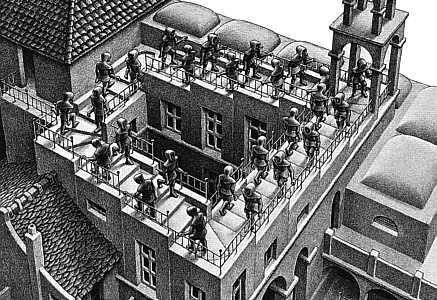
M.E. Escher - Up and Down
By Ashvin Pandurangi
The latest revolution of the Euro Crisis Cycle has brought us back to talks of restructuring Greek sovereign debt through "Private Sector Involvement" (PSI), which are somehow taking place in a Universe where debt restructuring is not allowed to be confused with "debt default" or "bankruptcy". On Friday January 20, the IIF (representing some of Greece’s creditors) and the Greek government announced that they had finally reached an "agreement" on the basic structure of the restructuring (or the basic restructuring of the structure?).  

Here’s the 
live blog update from The Guardian on Friday, which really stood out to me:

A framework of the deal -- the basic structure of the bond swap that the Greek finance minister Evangelos Venizelos wants to present at Monday's eurogroup meeting -- has been accepted by both sides, "put in place" and I understand committed to paper.

But it would also seem that other aspects of the agreement - be them legal, technical or matters of substance -- remain unresolved and will be discussed at negotiations that resume at 7:30pm local time [6.30 GMT] and look set to continue over the weekend
.

The happy warrior

ON RESISTING EVIL
By M. Rothbard
How can anyone, finding himself surrounded by a rising tide of evil, fail to do his utmost to fight against it? In our century, we have been inundated by a flood of evil, in the form of collectivism, socialism, egalitarianism, and nihilism. It has always been crystal clear to me that we have a compelling moral obligation, for the sake of ourselves, our loved ones, our posterity, our friends, our neighbors, and our country, to do battle against that evil.
It has therefore always been a mystery to me how people who have seen and identified this evil and have therefore entered the lists against it, either gradually or suddenly abandon that fight. How can one see the truth, understand one's compelling duty, and then, simply give up and even go on to betray the cause and its comrades? And yet, in the two movements and

The privileged clique

Putting plankton before people
Eco-warriors who campaign against the building of dams are damning the poor to live at nature’s mercy.
by Nick Thorne 
A good example of the ‘case against big dams’ was presented in a recent article for Al-Jazeera by Lori Pottinger of California-based NGO International Rivers, which campaigns against large dams and to promote ‘living rivers’. She wrote that ‘large dams have wiped out species; flooded huge areas of wetlands, forests and farmlands; displaced tens of millions of people, and affected close to half a billion people living downstream’. So if big dams have such damaging consequences for the planet’s inhabitants and its flora and fauna, how could anyone be in favour of them?
Well, Pottinger’s argument is simply flawed, with her outlook being typical of the worst kind of misanthropy. She begins with an emotive but meaningless extended metaphor: ‘Rivers act as the planet’s circulatory system. Like our body’s circulation system, the planetary

The Loan

An Exchange of Wealth for Income
by Keith Weiner
As the title of this essay suggests, a loan is an exchange of wealth for income. Like everything else in a free market (imagine happier days of yore), it is a voluntary trade. Contrary to the endemic language of victimization, both parties regard themselves as gaining thereby, or else they would not enter into the transaction. 
In a loan, one party is the borrower and the other is the lender. Mechanically, it is very simple. The lender gives the borrower money and the borrower agrees to pay interest on the outstanding balance and to repay the principle. As with many principles in economics, one can shed light on a trade by looking back in history to a time before the trade existed and considering how the trade developed.
It is part of the nature of being a human that one is born unable to work, living on the surplus produced by one’s parents. One grows up and then one can work for a time. And then one becomes old and infirm, living but not able to work. If one wishes not to starve to death

Monday, January 23, 2012

Common Criminals

To the memory of Wilman Villar Mendoza
By Yoani Sanchez
A couple of years ago, my friend Eugenio Leal decided ask for the report of his criminal record, necessary paperwork when applying for certain jobs. With confidence, he applied for the form where it would say he had never been convicted of any crime but found, in its place, a disagreeable surprise: it appeared that he was the perpetrator of a “robbery with force” in the town where he’d been born, although in fact he had never even run a red light. Eugenio protested, because he knew this wasn’t a bureaucratic error nor a mere accident. His activities as a dissident had already made him the victim of repudiation rallies, arrests and threats, and now a blot on his criminal record had been added. He had gone from being a member of the opposition to someone with a past as a “common criminal,” something very useful to the political police to discredit him.

Sailing fully loaded

Our Many Layers of Entitlement 
    the entitlement mindset includes much more than government benefits programs.
The word entitlement commonly refers to government benefits to which we are entitled as taxpayers and/or citizens/residents. But there are layers of entitlement in the American psyche far beyond government benefits programs.
Let's start with the government benefits entitlements. The programs most people refer to as entitlements are Social Security and Medicare, which taxpayers pay for with payroll taxes (even if the money just goes into one giant Federal pot).
Beyond these "I paid into them" entitlements are the "welfare" entitlements of Medicaid, Section 8 Housing, SNAP/food stamps, etc., which are paid out of general tax revenues and which are

United Welfare States of America

In 2011 Nearly Half The Population Received Some Form Of Government Benefit
by Zero Hedge
While politicians may debate whether or not America is the most "generous" (with other generations' money of course) socialist welfare state in the history of mankind, the undoctored numbers make the affirmative case quite clear and without any chance for confusion. The single most disturbing statistic: in 2011 nearly half of the population lived in a household that receives some form of government benefit, which in turn accounted for 65% of total federal spending, or $2.5 trillion, and amount to 15% of GDP. And yet some people out there still think these people, long since indoctrinated to do little but mooch off the welfare state (which will continue subsidizing its existence so long as debt rates are so low that the government can issue trillions each year without fears of consequences) will halt their iTunes purchases, will voluntarily stop subsisting on the government's teat, or will rebel against a government which is their only source of income? Why? Especially since something tells us that there will be a peculiar overlap between this 50% and the 50% of Americans that pay zero taxes.
Of course, this chart should be observed in conjunction with the "What is this?" chart we presented two days ago from Morgan Stanley which pretty much explains everything about the US "economy"

Show me

Where Should the Burden of Proof Rest?
Perhaps you have been struck, as I have been repeatedly over the years, by the way in which certain disputes are framed. A writer, reporter, or discussant recognizes a difference of views on some matter: A maintains X, and B maintains Y. Yet, even though a difference is acknowledged, the question is resolved by concluding that X must be the case because B has not proven that Y is the case.  This conclusion is often reached only on the assumption that A does not, or should not, bear a similar burden of proof.
Libertarians, for example, constantly encounter this situation when they argue against state provision of some good or service currently provided by the state. The libertarians might argue, say, that private suppliers can provide personal security in better quality or at lower cost than the government police can. Critics claim that the

We are doomed

The rule of law and other fairy tales

Fiat money is doomed anyway

Making the Transition to a New Gold Standard
by Larry White 

Nixon Ending The Gold Standard

Suppose for the sake of argument that we all agree to the following proposition: If we could change the monetary regime with zero switching cost, merely by snapping our fingers, we would prefer the US to be on a gold standard. In the most general terms a gold standard means a monetary system in which a standard mass (so many grams or ounces) of pure gold defines the unit of account, and standardized pieces of gold serve as the ultimate media of redemption. Currency notes, checks, and electronic funds transfers are all denominated in gold and are redeemable claims to gold.[1] The question then arises: What would be the least costly way for the United States to make the transition to a new gold standard? We need to choose a low-cost method to insure that the agreed benefits of being on the gold standard exceed the costs of switching over.
Two transitional paths suggest themselves. (1) One path is to let a parallel gold standard grow up alongside the current fiat dollar. (2) The more conventional path, as followed after the suspension of the gold standard during the US Civil War, is to set a date after which the US dollar is to be meaningfully defined as so many grams of pure gold. Or as it is more commonly put, an effective parity is established

Sunday, January 22, 2012

The politics of war

Stop the Madness
Despite all the hype, Iran's nuclear program has yet to violate international law. It's time to calm down, think, and above all halt the rush to war.
BY YOUSAF BUTT 
Olli Heinonen is alarmed that Iran has begun producing 20 percent enriched uranium at a new, deeply buried site, and calculates that Iranian scientists could further purify the material to the 90 percent enrichment needed for a bomb in about six months' time. This prediction, however, is based on unsubstantiated assumptions regarding Iranian intentions, and only serves to provide ammunition for hawks in Washington that would rush the United States into another destructive war in the Middle East.
If Tehran enriched uranium to 90 percent, it would be forced to break its four decade-long adherence to the Nuclear Non-Proliferation Treaty (NPT) -- a momentous step that would likely prompt swift military action from the United States or Israel. Furthermore, Heinonen fails to mention that, according to the International Atomic Energy Agency, "All nuclear material in the facility remains under the

Deceits and delusions

The euro-crisis and democracy
by DETLEV SCHLICHTER
Anybody with any knowledge of economics should feel uneasy at the sight of a country where half of recorded economic activity is conducted by the state. Are such semi-socialist societies operable, and if so, for how long? That complete socialism is impossible and that any attempt to establish it must fail, we know for sure since Ludwig von Mises explained it in detail in 1922 with his masterly Die Gemeinwirtschaft (Socialism). The only reasons that the Soviet Union did not collapse earlier but managed to drag out its persistent economic decline for seventy-odd years are that it introduced full socialization to no more than seventy percent of its economy, and that it had its bureaucrats constantly peek through the Iron Curtain and observe market prices in the capitalist West to be able to

Corporatocracy Has Replaced Capitalism

Why We Are Totally Finished
Corporatocracy: A government that serves the interest of, and may de facto be run by corporations.
By D Sherman Okst
Capitalism Fixes Problems & Preserves Democracy: Capitalism is what we should be relying on to fix our problems. Capitalism has it's own ecosystem, just like biology's ecosystem. An economic ecosystem that weeds out the weak, has parasites that eat the failures and new bacteria that evolves and grows replacements for

Teaching and common sense

How’s My Teaching?
More policymakers are adopting evaluation systems based on classroom performance.
By MARCUS A. WINTERS
New York mayor Michael Bloomberg, New York governor Andrew Cuomo, and New Jersey governor Chris Christie are the latest high-profile policymakers to pursue radical changes in the evaluation of public school teachers. While the policy details—in particular, how they would use students’ test scores to evaluate teachers—get the most attention, the most promising aspect of these proposals is that they represent a fundamental shift in philosophy. The new approach is much better aligned with what we now know about teachers and how we should employ them.
Under the current system, public schools measure teacher quality by placing heavy weight on a set of professional credentials. In order to enter the classroom, a prospective teacher must earn a degree from an education college and must be certified. Teachers earning advanced degrees get rewarded with higher salaries.

The secret contract

The Secret Document That Transformed China
Yen Jingchang was one of the signers of the secret document.
by DAVID KESTENBAUM and JACOB GOLDSTEIN
In 1978, the farmers in a small Chinese village called Xiaogang gathered in a mud hut to sign a secret contract. They thought it might get them executed. Instead, it wound up transforming China's economy in ways that are still reverberating today.

The contract was so risky — and such a big deal — because it was created at the height of communism in China. Everyone worked on the village's collective farm; there was no personal property.

"Back then, even one straw belonged to the group," says Yen Jingchang, who was a farmer in Xiaogang in 1978. "No one owned anything."

At one meeting with communist party officials, a farmer asked: "What about the teeth in my head? Do I own those?" Answer: No. Your teeth belong to the collective.

In theory, the government would take what the collective grew, and would also distribute food to each family. There was no incentive to work hard — to go out to the fields early, to put in extra effort, Yen Jingchang says.

"Work hard, don't work hard — everyone gets the same," he says. "So people don't want to work."

In Xiaogang there was never enough food, and the farmers often had to go to other villages to beg. Their children were going hungry. They were desperate.


Gentlemen, Choose Your Disaster

Staring into the Abyss
By John Mauldin
"If we want everything to stay as it is, everything will have to change."
– from The Leopard by Giuseppe Tomasi di Lamedusa
"The crisis takes a much longer time coming than you think, and then it happens much faster than you would have thought, and that's sort of exactly the Mexican story. It took forever and then it took a night."
– Rudiger Dornbusch
Europe's leaders are committed to keeping both the euro and the eurozone as it is. But for it to do so, everything must change, as the wonderful quote from the 1958 Italian novel suggests. This is no easy task, as no one wants a change that will impact them negatively; and there is no change that will allow things to stay the same that does not impact all severely, as we will see. 
The choices we make today are constrained by the choices we made in the past, and the choices we make in the future will be limited by the choices we make today. Europe chose to create a free trade

Saturday, January 21, 2012

Making investments that actually make sense

Shifting Capital From the Productive to the Sexy
By Warren Meyer
Siemens Velaro China (Velaro CN / CRH3
Sexy black hole for money.
But did we mention it was sexy? 
What is it about intellectuals that seem to, generation after generation, fall in love with totalitarian regimes because of their grand and triumphal projects?  Whether it was the trains running on time in Italy, or the Moscow subways, or now high-speed rail lines in China, western dupes constantly fall for the lure of the great pyramid without seeing the diversion of resources and loss of liberty that went into building it.

Writers like Thomas Friedman and Joel Epstein in the Huffington Post have eulogized China and its monumental spending projects.    These are the same folks who, generations ago, tried disastrously to emulate Mussolini’s “forward-thinking” economic regime in the National Industrial Recovery Act.  These are the same folks who wanted to emulate MITI’s management of the Japanese economy (which drove them right into a 20-year recession).  These are the same folks who oohed and ahhed over the multi-billion dollar Beijing

The fragility of civilization


The Sinking of the West
By Mark Steyn
Abe Greenwald of Commentary magazine tweets:
"Is there any chance that Mark Steyn won’t use the Italian captain fleeing the sinking ship as the lead metaphor in a column on EU collapse?"
Oh, dear. You’ve got to get up early in the morning to beat me to civilizational-collapse metaphors. Been there, done that. See page 185 of my most recent book, where I contrast the orderly, dignified, and moving behavior of those on the Titanic (the ship, not the mendacious Hollywood blockbuster) with that manifested in more recent disasters. There was no orderly evacuation from the Costa Concordia, just chaos punctuated by individual acts of courage from, for example, an Hungarian violinist in the orchestra and a ship’s entertainer in a Spiderman costume, both of whom helped children to safety, the former paying with his life.
The miserable Captain Schettino, by contrast, is presently under house arrest, charged with manslaughter and abandoning ship. His explanation is that, when the vessel listed suddenly, he fell into a lifeboat and was unable to climb out. Seriously. Could happen to anyone, slippery decks and all that. Next thing you know, he was safe on shore, leaving his passengers all at sea. On the other hand, the audio of him being ordered by Coast Guard officers to return to his ship and refusing to do so is not helpful to this version of events.